Photo: © Fraunhofer ISE / Modellregion Agri-PV
Vera Meridian Insights

The Sun, Twice Over


Agrivoltaics raises solar panels high enough to farm beneath them, declining the assumed tradeoff between clean power and farmland. An introduction to how it works, what the field science now shows, and why it matters most in the sun-rich, water-short Global South. It is the first of a three-part series.

By Justin Miller · June 24, 2026 · ~20 min read · 30 sources · Part 1 of 3

← Back to Insights I · The Idea

What Agrivoltaics Actually Is


Every serious plan to slow climate change runs through the same chokepoint. Roughly three-quarters of global greenhouse-gas emissions come from the way the world produces and uses energy[1], and the cheapest tool now available for cutting them is solar power. But solar at the scale the climate arithmetic demands is hungry for land, and the flattest, sunniest, most accessible ground is usually already growing food. So the world keeps being handed a choice it does not want to make: clean power, or farmland. Agrivoltaics is the rare idea that declines the choice.

At its simplest, agrivoltaics is the deliberate sharing of one piece of land between solar panels and crops. A conventional solar farm is optimized for a single output, maximum electricity, and it treats the ground beneath the modules as dead space. An agrivoltaic system is optimized for two outputs at once, and that changes the engineering: the panels sit higher, the rows sit farther apart, and the array is designed to let a deliberate fraction of sunlight reach the plants below.

Max Trommsdorff, who led the agrivoltaics research group at Germany's Fraunhofer Institute for Solar Energy Systems (ISE), puts the definition plainly: "The idea is that AV combines agricultural production and photovoltaic electricity generation on the same piece of land. Fields, orchards or pastures are fitted with solar modules in such a way that farming can continue underneath or between them."[2] The exact layout follows the crop. Over orchards and vineyards, roof-like canopies let tractors drive down the rows. On arable fields, modules stand in spaced rows so enough light reaches the soil. Above pasture, the panels are arranged so sheep or cattle can graze beneath them.

Practitioners sort these systems into a few families. Fraunhofer ISE distinguishes overhead systems, where panels are mounted several meters above the ground on stilts so crops and machinery pass underneath, from interspace systems, where rows of panels sit closer to the ground and crops grow in the gaps between them.[3] A third category, enclosed structures such as solar greenhouses, mounts the panels on the structure itself. A newer variant stands the panels vertically, often using bifacial modules that capture light on both faces, so the rows behave like fences between strips of cultivated land.

The Four Families, Seen in the Field

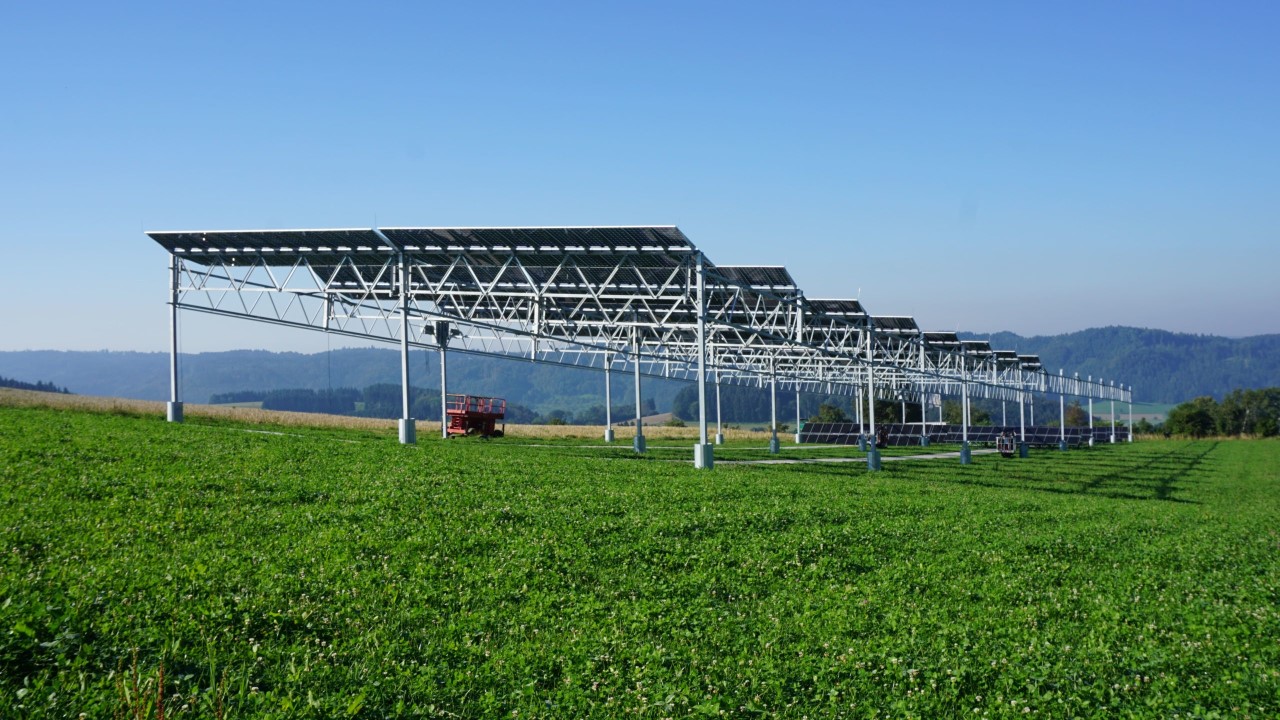
1 · Overhead

Panels raised several meters on posts, so crops and full-size machinery pass underneath.
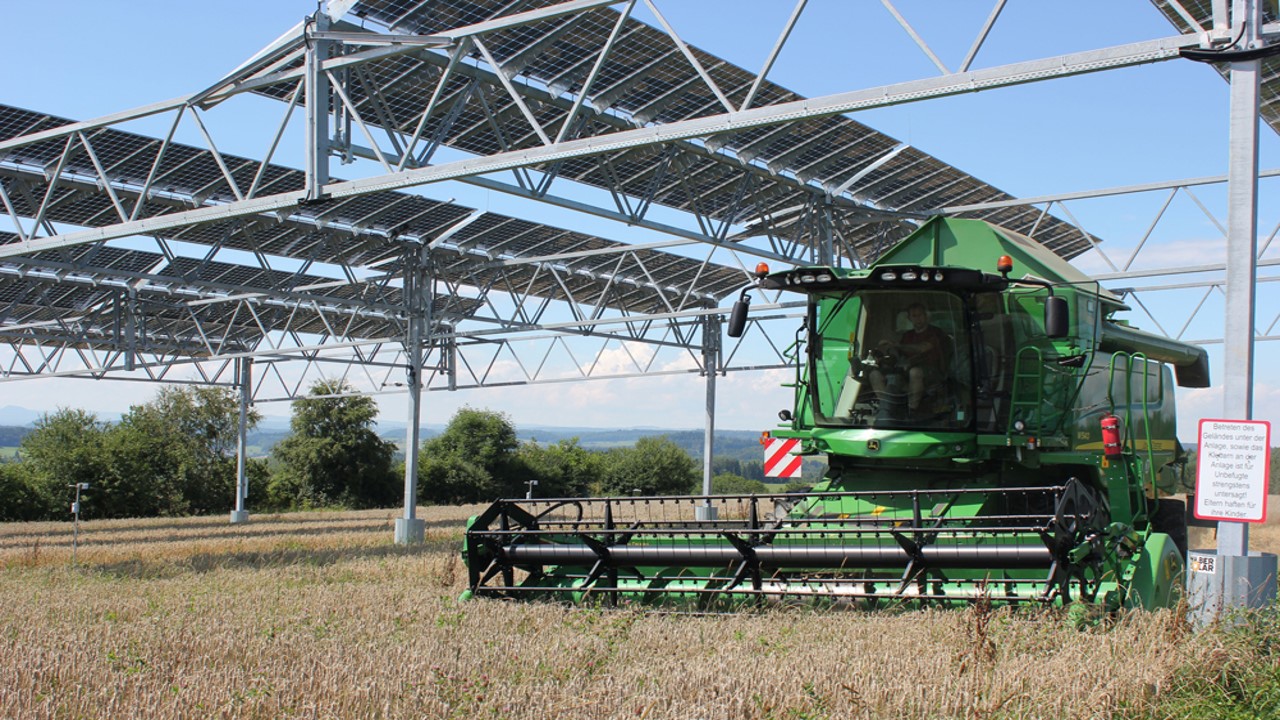
Combine harvesting wheat beneath an elevated array
A combine harvests wheat directly beneath an elevated array; the panels sit high enough to clear the machine.Photo: © Fraunhofer ISE · ise.fraunhofer.de
Long row of an elevated array over a green clover field
The elevated structure runs in long rows over a clover-grass field, generating power while the forage grows below.Photo: © Fraunhofer ISE · ise.fraunhofer.de

2 · Interspace

Lower panel rows, with crops grown in the open gaps between them.
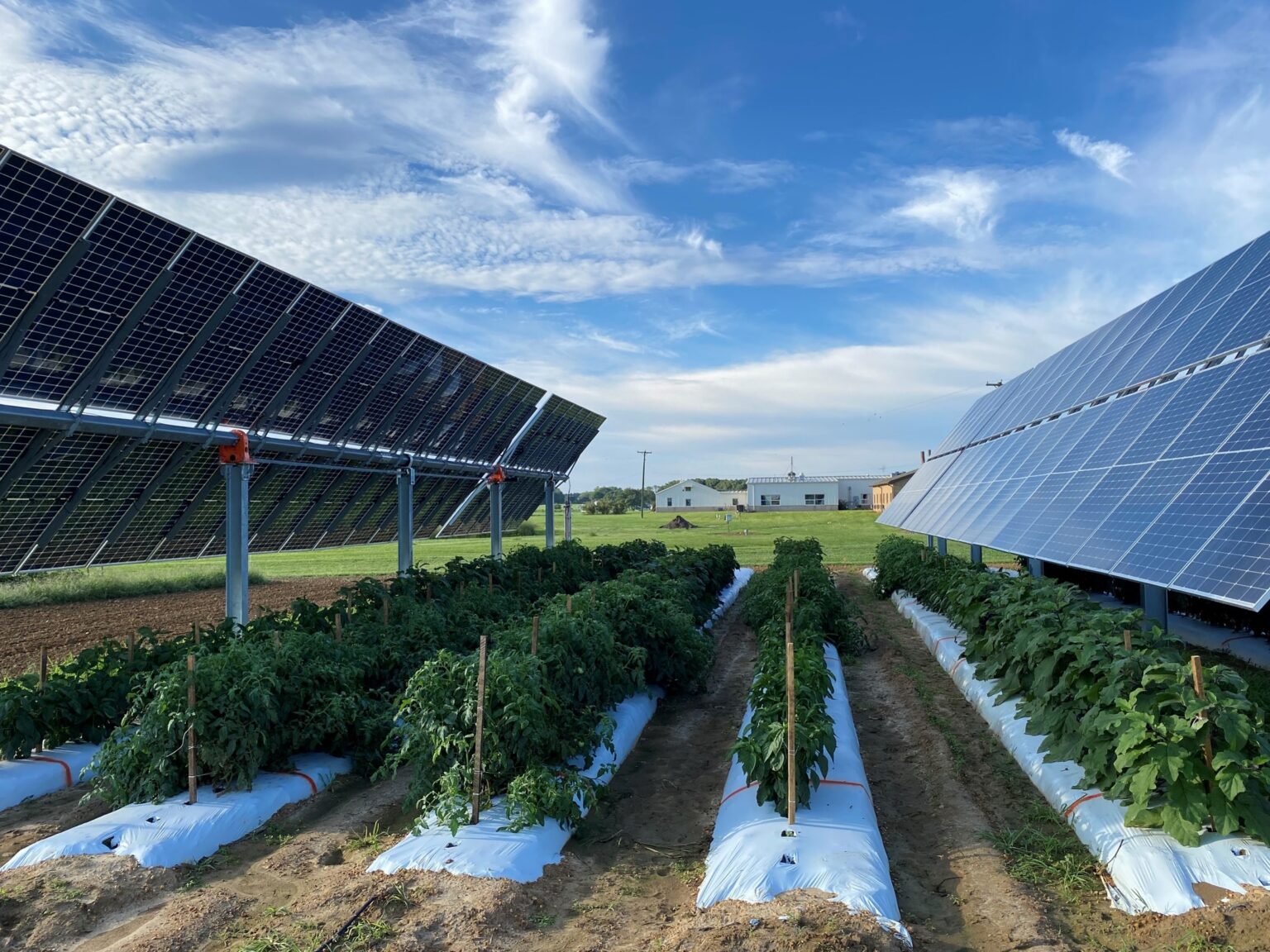
Tomato, eggplant and pepper rows between two tracker rows
Tomato, eggplant and pepper rows grow in the lane between two tracker rows, sharing the same ground as the panels.Photo: © Rutgers Agrivoltaics Program · agrivoltaics.rutgers.edu
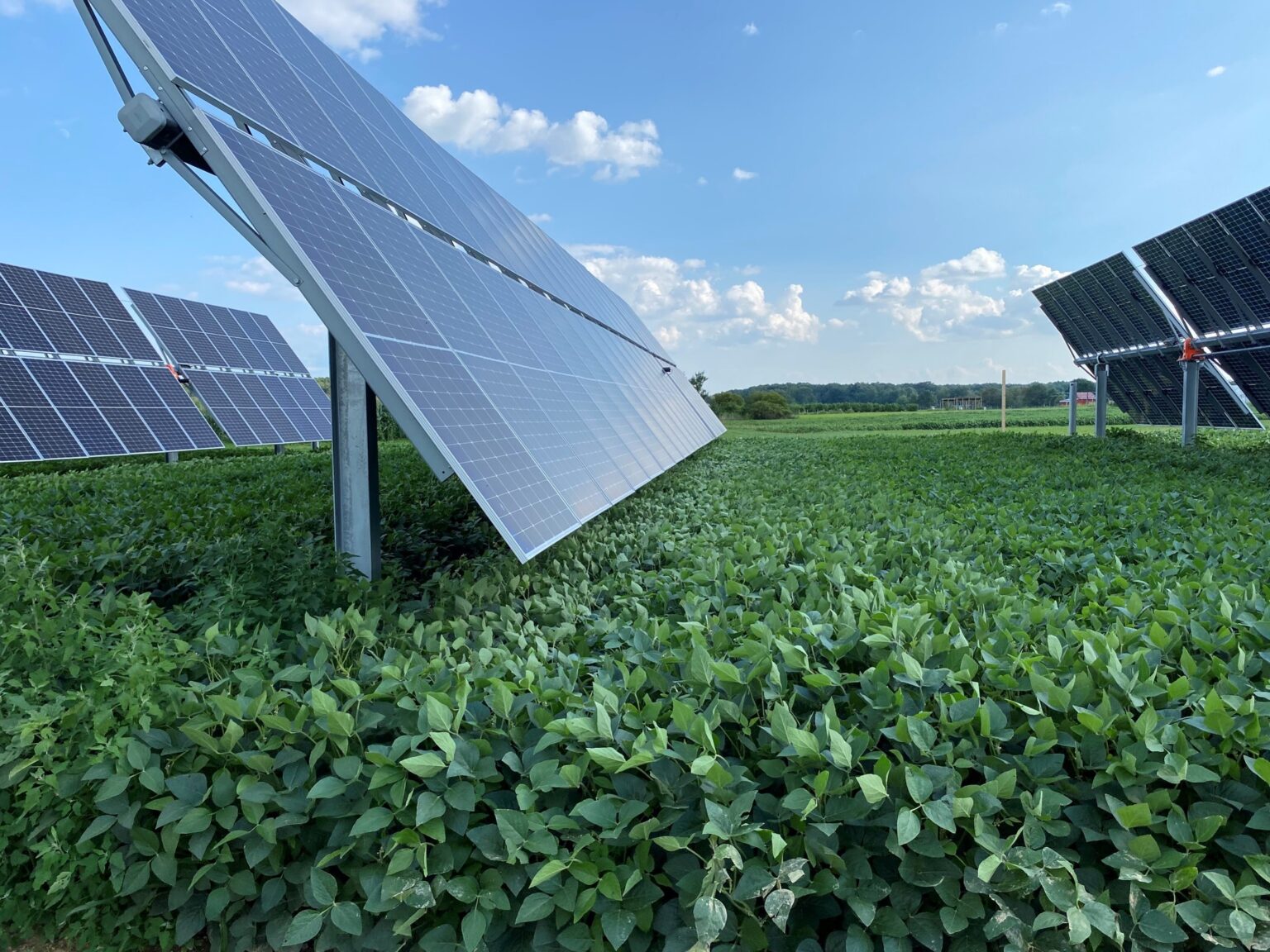
Tracker panel tilted above a soybean canopy
A single-axis tracker tilts above a full soybean canopy at a Rutgers research site in New Jersey.Photo: © Rutgers Agrivoltaics Program · agrivoltaics.rutgers.edu

3 · Vertical (bifacial)

Upright two-sided panels in rows, standing like fences between strips of crop or pasture.
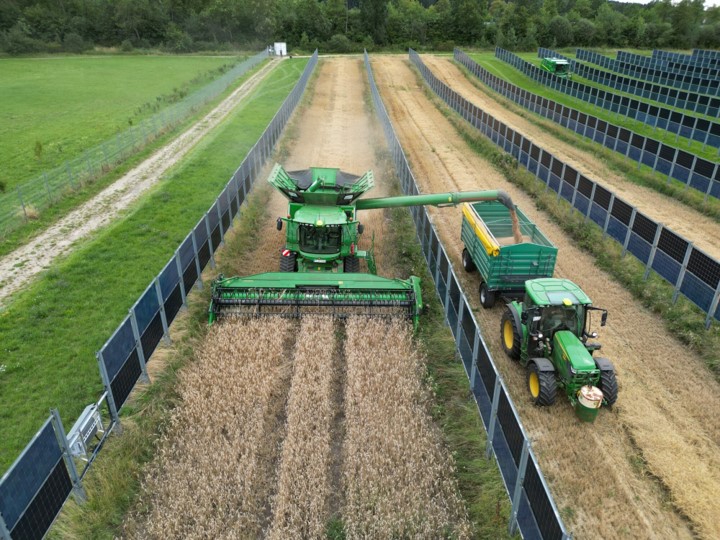
Combine and trailer harvesting grain between vertical rows
Combine and trailer bring in grain between the rows; the two-sided panels catch the low morning and evening sun on both faces.Photo: © Next2Sun · next2sun.de
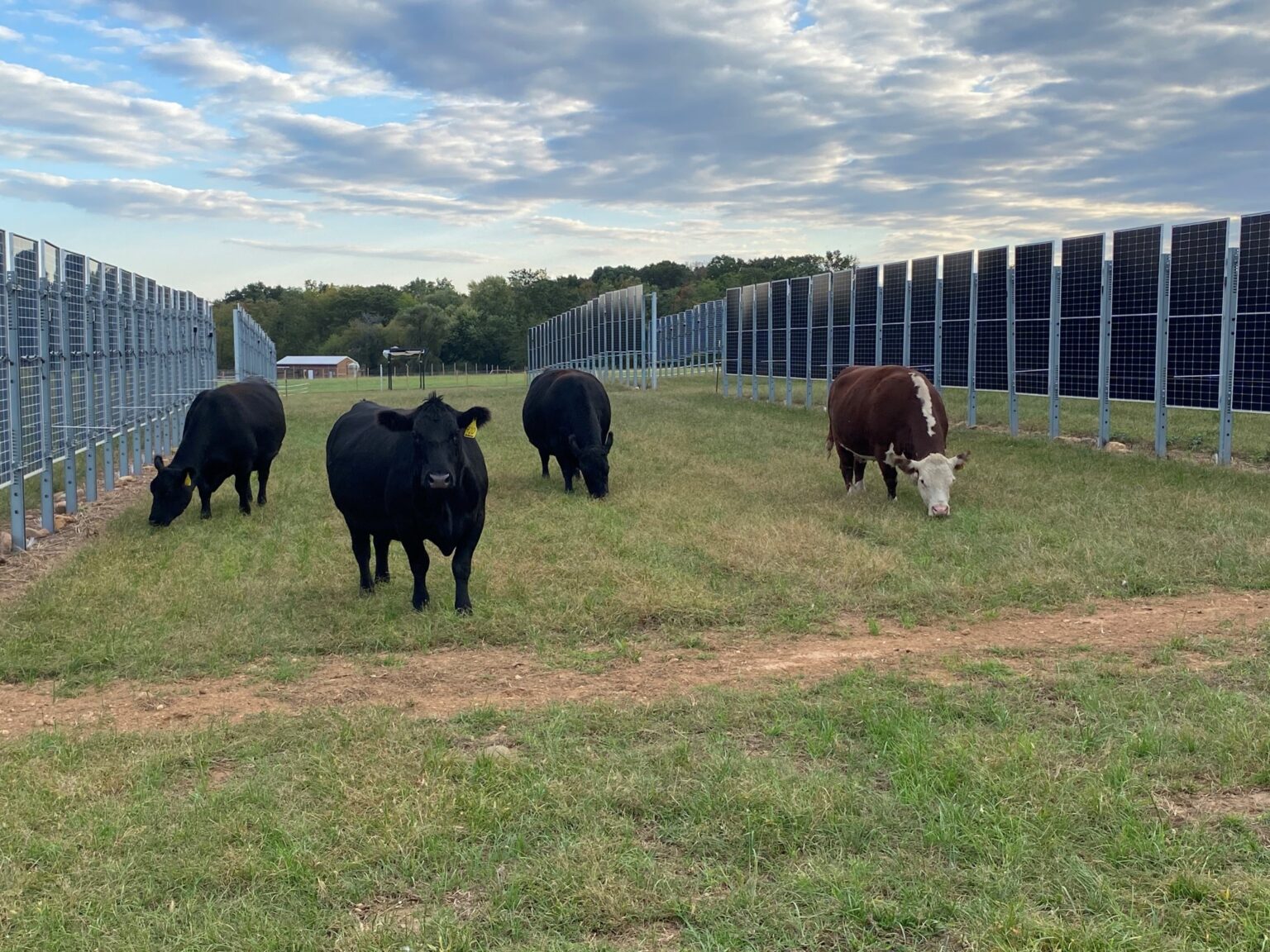
Beef cattle grazing between portrait-orientation vertical rows
Beef cattle graze between portrait-orientation vertical rows at a Rutgers site, pairing pasture with generation.Photo: © Rutgers Agrivoltaics Program · agrivoltaics.rutgers.edu

4 · Enclosed

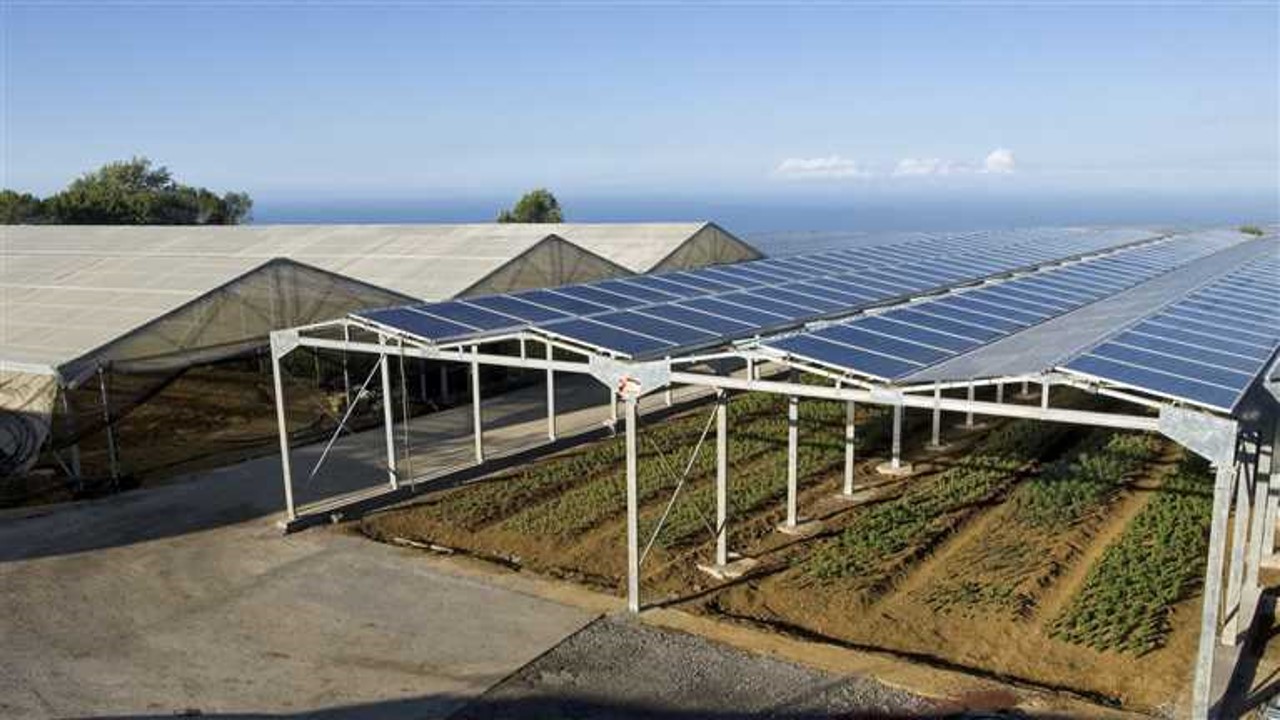
Closed greenhouse systems, where the panels are built into the structure and filter the light reaching the crop.
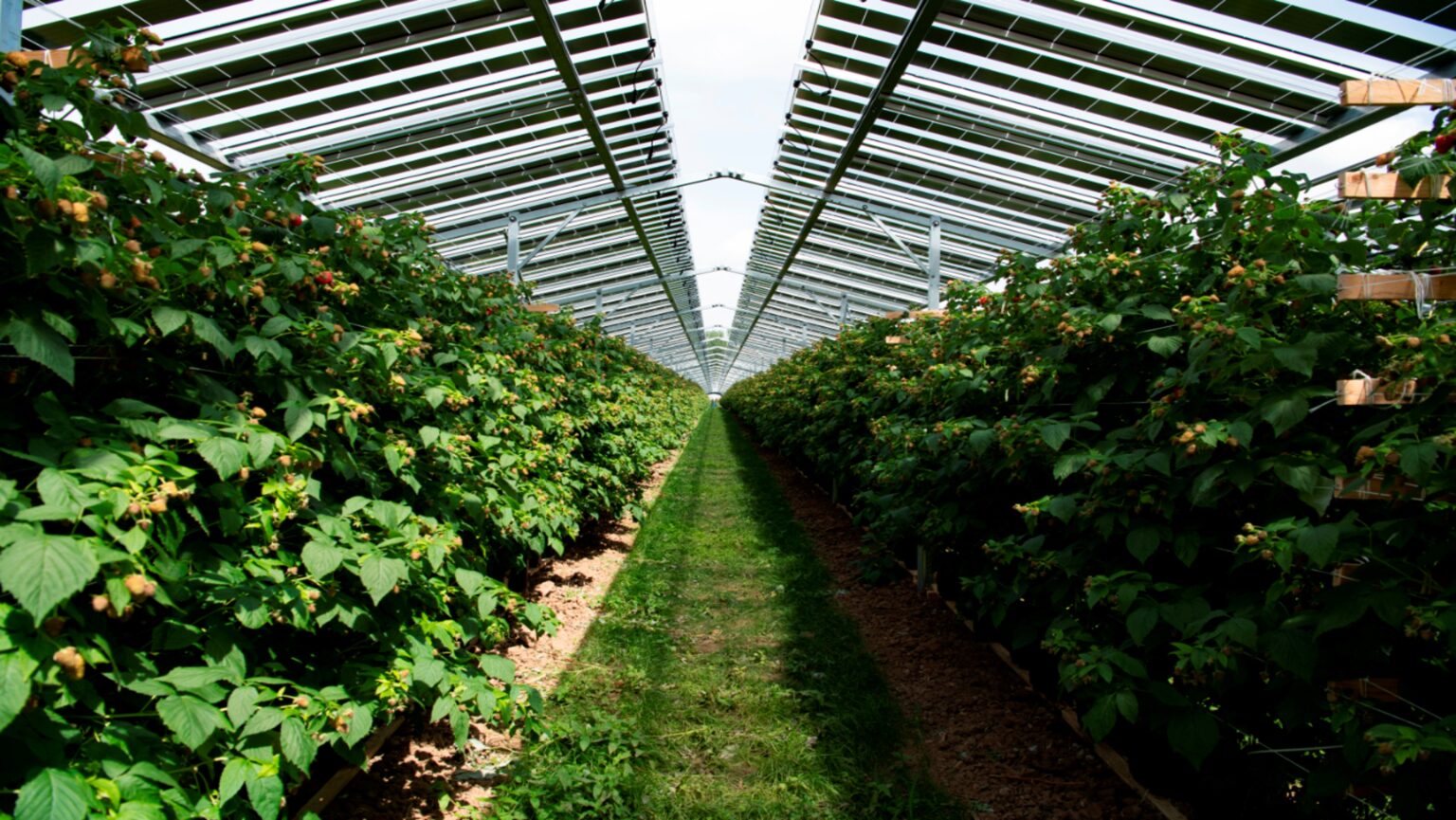
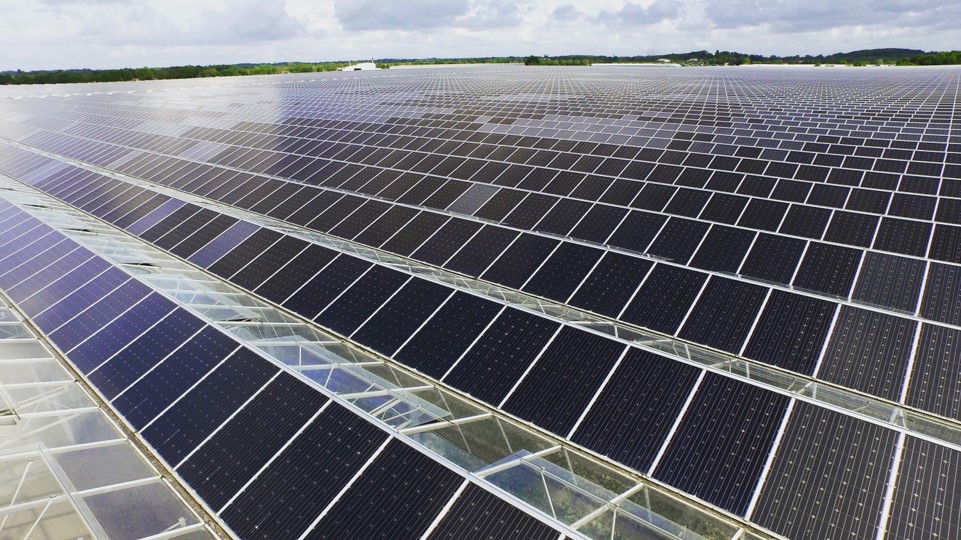
Raspberry rows under a partially translucent PV roof
Inside a greenhouse, a partly translucent photovoltaic roof shades raspberry rows while generating power overhead.Photo: © Regionale Energiestrategie · regionale-energiestrategie.nl
South-facing roof panels over seedling beds on a hillside greenhouse
South-facing roof panels cover seedling beds on a hillside greenhouse above the sea, combining propagation with generation.Photo: © SIC Solar · sic-solar.com
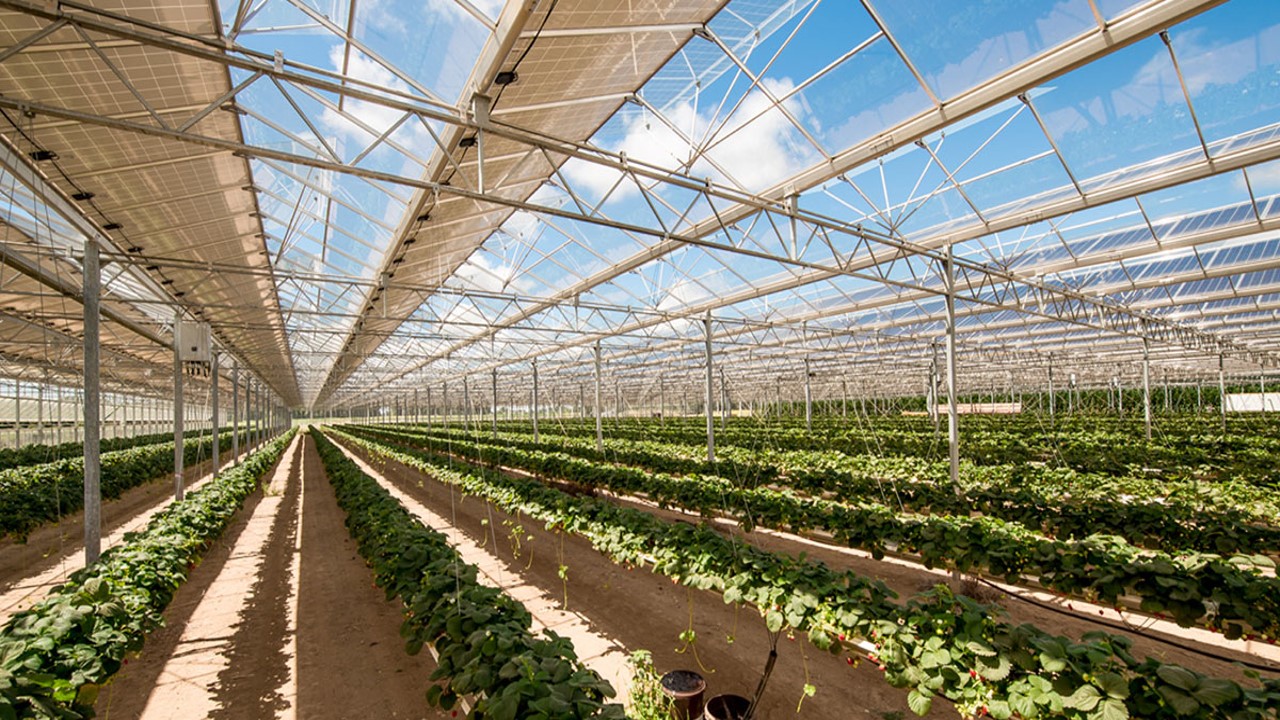
Strawberry greenhouse interior with paneled roof sections
Roof-integrated panels filter light across a commercial strawberry greenhouse, with no separate field needed.Photo: © Met Solar · metsolar.eu
Aerial close-up of a paneled greenhouse roof
A close view of a paneled greenhouse roof, where the modules themselves form part of the building.Photo: © Horconex · horconex.com

The design tension is always the same. Tilt the balance toward energy and you shade the crop too heavily; tilt it toward the crop and you give up generation. The whole discipline is the search for configurations where both outputs stay high enough to justify the shared land. What makes that search worth running is a counterintuitive fact: under the right conditions, the crop does not merely tolerate the panels. It can do better because of them.
II · The History

A Concept That Waited Thirty Years for Its Evidence


The idea arrived decades before anyone could prove it. In the early 1980s, physicist Adolf Goetzberger, the founder of Fraunhofer ISE, set down the proposition that a single plot could harvest sunlight twice, once as electricity above and once as food below. His Freiburg paper carried the almost folkloric title "Kartoffeln unter dem Kollektor," potatoes under the collector.[2] With his colleague Armin Zastrow he even sketched the engineering the field still uses: raise the collectors, widen the spacing, let roughly a third of the incoming light pass through to the plants.[4] For three decades it stayed on paper while photovoltaics fought its own battle to become affordable.

The thaw came from France. In 2011 a team led by Christian Dupraz gave the concept its modern name, agrivoltaics, and built the first serious model of its land-use logic, using the land-equivalent ratio to compare a shared plot against the two single uses it replaced.[5] The land-equivalent ratio is the workhorse metric of the field: it asks how much single-use land you would need to match what the co-located system produces together. A ratio above 100% means the combined plot beats the sum of its separate parts.

What turned the model into measured agronomy was field hardware, and the cleanest early example came back to Fraunhofer. In 2016 the institute helped build a pilot on a community-owned organic farm at Heggelbach, near Lake Constance, where 720 bifacial modules totaling about 194 kilowatts-peak were raised roughly five meters above working farmland.[3] Beneath them, researchers grew four crops, winter wheat, potatoes, celeriac and grass-clover, against an adjacent open plot.[6] Trommsdorff dates the field's turning point to that site: "The breakthrough happened in 2018," he recalls, during an exceptionally dry spring and summer, when "three of the four arable crops grown under the semi-shaded PV modules produced higher yields than the control plot in full sun," on top of the electricity the panels generated.[2]

That measurement settled the central question: the land could be worth more than the sum of its single uses. At Heggelbach, combined land-use efficiency reached roughly 160% in 2017[4], and in the hot summer of 2018 it climbed to as much as 186%, measured against the potato harvest.[7] A figure above 100% is the entire argument compressed into one number: the panels do not simply tax the field, they let it do two jobs at once.

The field has grown up fast around that result. Germany released the first technical standard for agrivoltaics, DIN SPEC 91434, in 2021, setting a quality floor: to count as a genuine agrivoltaic system rather than a solar farm with a token planting, a site must retain at least 66% of the agricultural yield it would produce without the panels.[2] The number of peer-reviewed publications, Trommsdorff notes, "has risen from virtually zero a decade ago to more than 150 per year."[2] By the time Fraunhofer published its agrivoltaics guideline, at least 2.8 gigawatts-peak of such systems had been installed worldwide.[3]

III · The Mechanism

Why the Crop Does Not Collapse Under Shade


The intuition that shade must cut yield in proportion to the light it removes is wrong in hot conditions, and it is wrong for a specific physiological reason. In heat and intense sun, many crops undergo a midday depression of photosynthesis: at peak irradiance the plant closes its stomata to limit water loss, and carbon assimilation stalls rather than rising with the extra light. Field research in hot, arid conditions found that the partial shade of an array mitigates that midday depression, lowering water stress while holding daily carbon assimilation and yield equal to or above full-sun controls.[8] Shade, under these conditions, is redistributing a surplus rather than deepening a deficit.

The same shade saves water. Because shaded plants transpire less, the soil holds more of its moisture. A French field study of lettuce found water use under the panels fell by roughly 14% to 29% through reduced evapotranspiration, with relative yield holding at or above the relative light available.[9] A separate field experiment recorded markedly higher soil moisture and improved water-use efficiency beneath an array.[10] Modeling of arid and semi-arid sites estimates that agrivoltaics can cut crop water consumption by 30% to 40% of the array's coverage level, and that some array-and-crop combinations push the land-equivalent ratio above 2, a doubling of output from the same ground.[11]

This is the inversion that matters. In a cool, cloudy, water-rich temperate zone, every photon is scarce and shade is mostly a cost to minimize. In a hot, high-irradiance, water-stressed climate, sunlight is abundant to the point of damage and water is what limits the harvest, so the calculus flips: the shade that costs a little yield in Germany can protect yield in the desert.

IV · The Evidence

What the American Research Stations Show


The hardest evidence for that inversion comes from the United States, where a cluster of universities and national laboratories has turned agrivoltaics from a European pilot into a measured science.

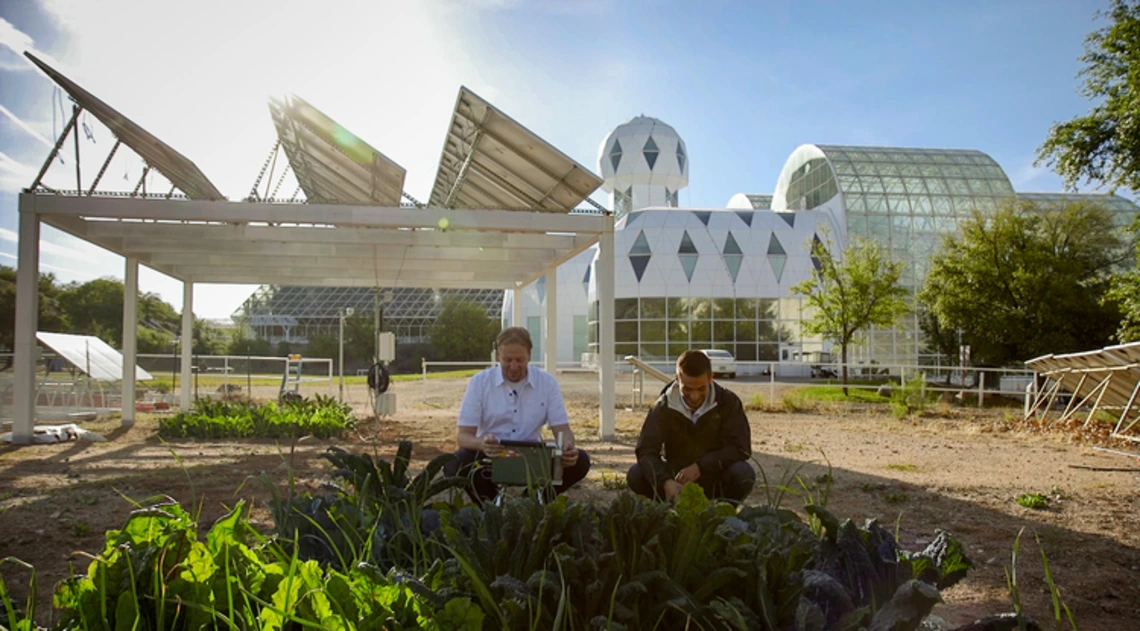
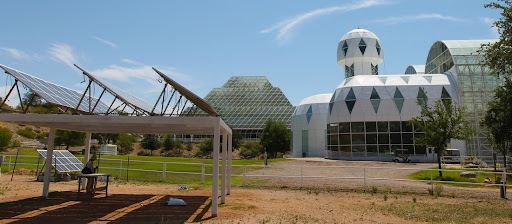
The University of Arizona produced the field's signature dryland result. On a research array in the arid Southwest, Greg Barron-Gafford and colleagues grew chiltepin pepper, jalapeño and cherry tomato beneath panels and against open controls. Total chiltepin fruit production was three times greater under the panels. Cherry tomato production was twice as great. Jalapeño matched its conventional yield while losing about 65% less water to transpiration. Soil under the panels held about 15% more moisture between waterings, and by shedding heat into plant transpiration rather than into the equipment, the modules themselves ran markedly cooler during daylight, so the crop was quietly improving the power yield even as the panels protected the crop.[12]

Researchers among crops beneath the elevated array at Biosphere 2
Researchers sit among crops growing under the University of Arizona's elevated array at Biosphere 2, near Tucson, the dryland work that recorded triple pepper yields and far lower water use.Photo: Bob Demers / University of Arizona · biosphere2.org
The Arizona agrivoltaic array beside the Biosphere 2 complex
The same research array stands beside the Biosphere 2 domes, where crops and panels are monitored side by side in the Arizona heat.Photo: © University of Arizona · biosphere2.org

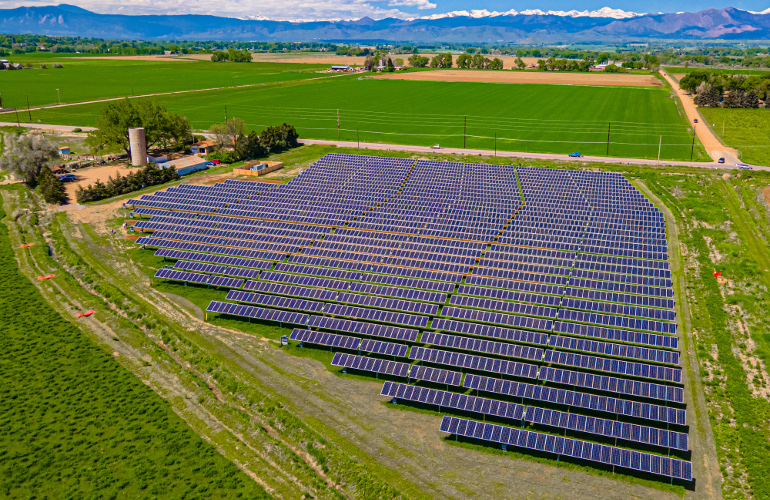
Colorado State University extended the work from desert vegetable plots to the grasslands that cover much of the dry American West. Working with Cornell University at Jack's Solar Garden in Longmont, the largest commercial agrivoltaics research site in the country, a team led by Alan Knapp and Matthew Sturchio ran four years of measurements on grass grown under and around a solar array. Their 2025 finding, in Environmental Research Letters, is that the panels reduced water stress, improved soil moisture and, in dry years, raised plant growth by about 20% or more; on the east side of the panels, dry-year grass production ran as much as 90% higher than the neighboring open site.[13]

"Even though this solar array was designed to maximize energy generation, not to promote beneficial environmental conditions for the grasses grown beneath, it still provided a more favorable environment during a dry year."

Matthew Sturchio, Cornell University[13]
Aerial of Jack's Solar Garden in Longmont, Colorado
Jack's Solar Garden in Longmont, Colorado, the largest commercial agrivoltaics research site in the country, where Colorado State and Cornell ran four years of grassland measurements.Photo: Namaste Solar / Jack's Solar Garden · jackssolargarden.com
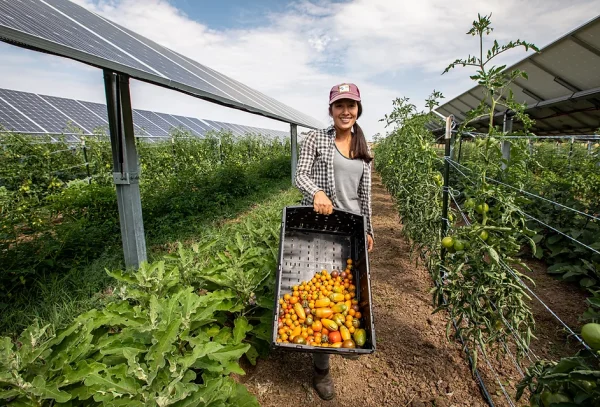
A grower carrying harvested tomatoes between panel rows
A grower carries tomatoes harvested in the rows between the panels at Jack's Solar Garden, where crops and forage share the array.Photo: Jack's Solar Garden · jackssolargarden.com

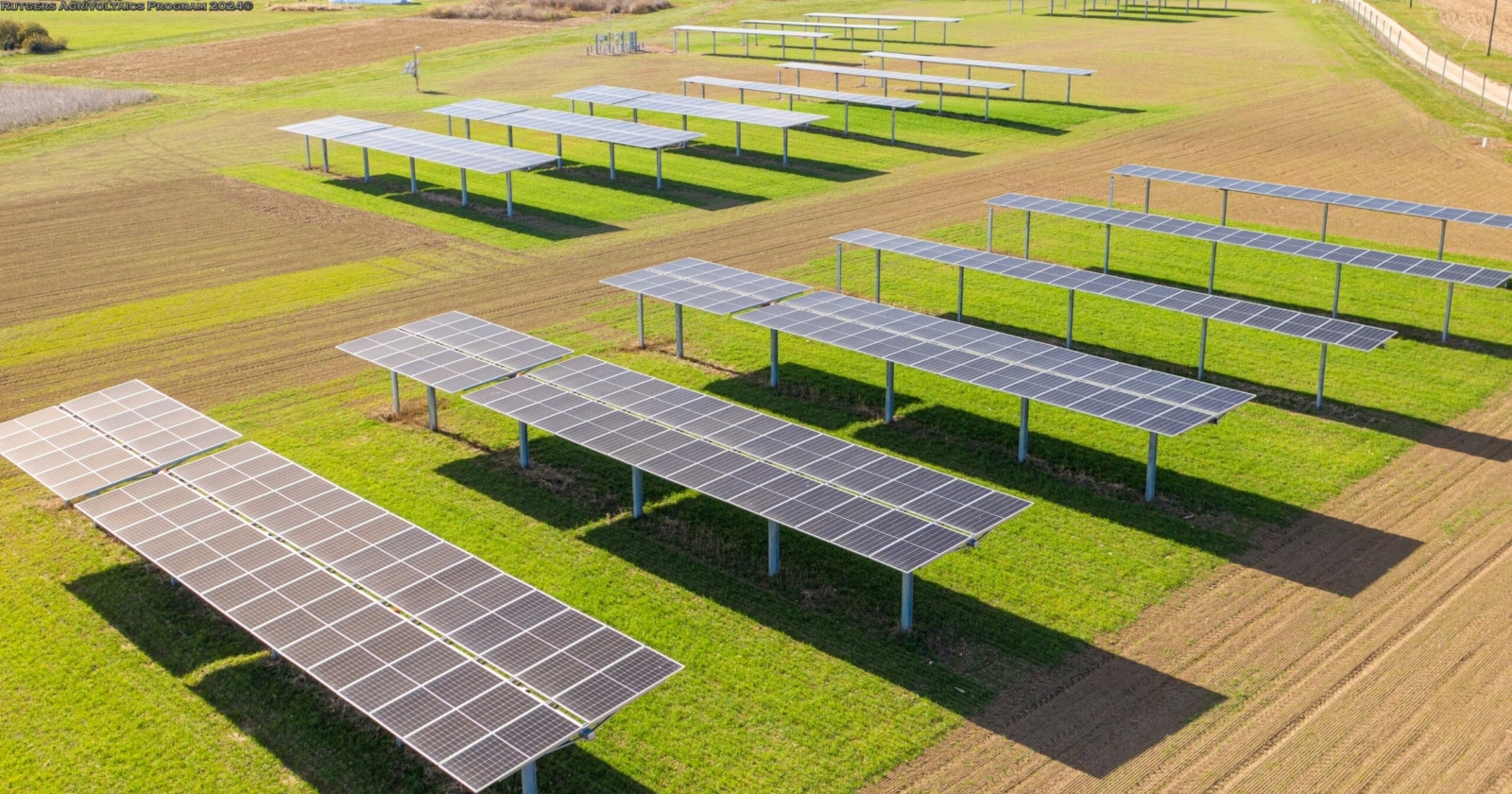
Rutgers University carries the work into the humid, densely farmed conditions of the eastern United States, paired with a deliberately practical "Farmers First" approach. The Rutgers Agrivoltaics Program, led by Dave Specca at the New Jersey Agricultural Experiment Station, runs a three-site research network: a 255-kilowatt array testing vegetables and soybeans in South Jersey, a 95-kilowatt array on hay ground in the hillier northwest, and an animal farm studying beef-cattle grazing beneath vertical bifacial panels. In first-year trials, soybean production rose in the panel plots relative to open controls, and the program was recognized as North American agrivoltaics "Solar Farm of 2025."[29]

Aerial of a Rutgers agrivoltaics research array in New Jersey
Part of the Rutgers Agrivoltaics Program's three-site network in New Jersey, the research arrays test vegetables, soybeans, hay and grazing beneath the panels.Photo: © Rutgers Agrivoltaics Program · agrivoltaics.rutgers.edu
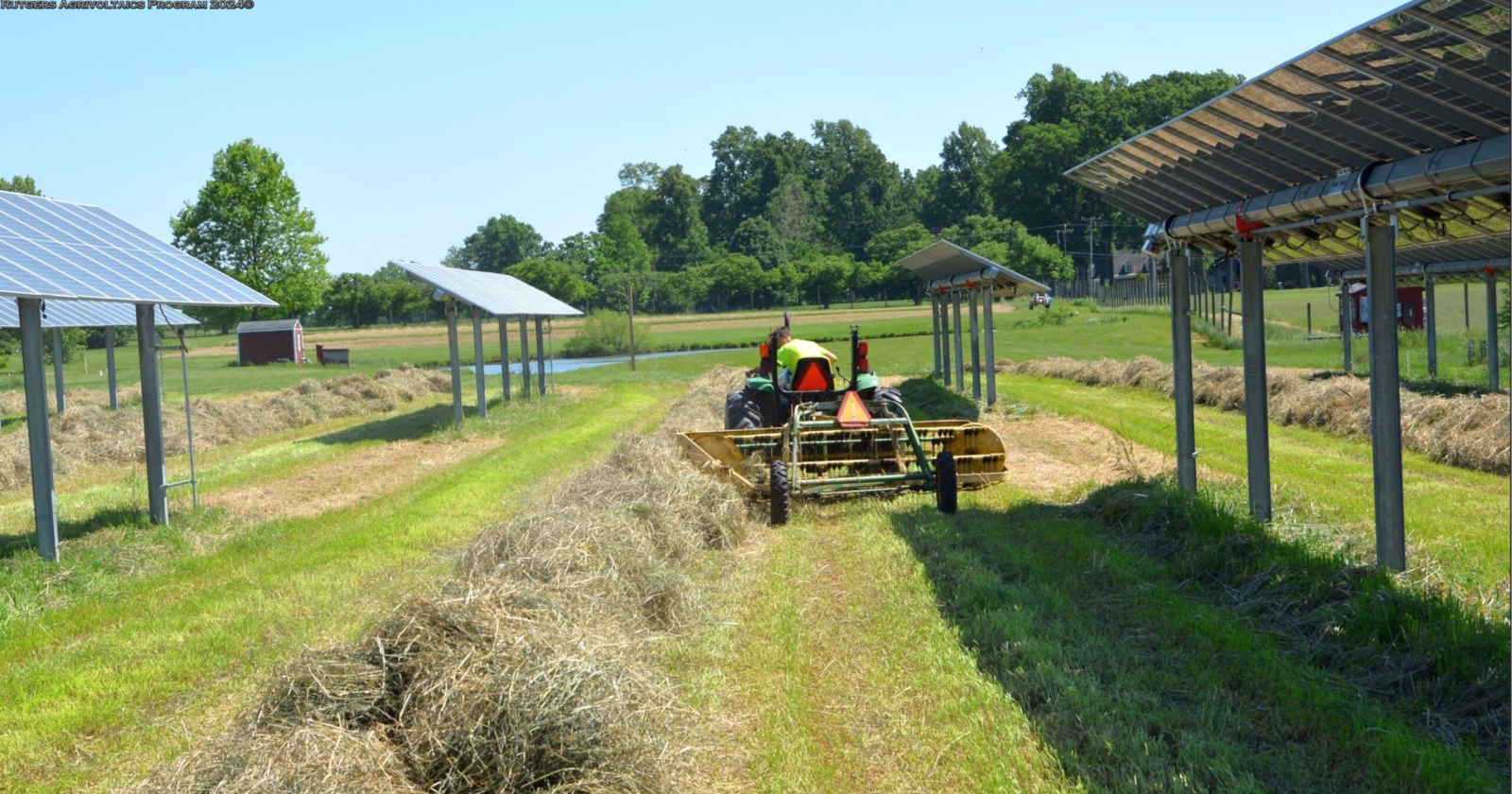
Tractor raking hay between rows of overhead panels at the Rutgers Snyder farm
At the Rutgers Snyder Research and Extension Farm in northwestern New Jersey, a tractor rakes hay between rows of overhead panels, the program's hay-and-forage site.Photo: © Rutgers Agrivoltaics Program · agrivoltaics.rutgers.edu

Tying these sites together is the National Renewable Energy Laboratory (NREL), whose InSPIRE project is the most comprehensive coordinated agrivoltaics effort in the United States, with trials at more than 25 sites. In hot and arid environments, InSPIRE found that agrivoltaics mitigated the midday depression in photosynthesis, reduced water stress, and produced equal or greater yield across the crops tested, which led the researchers to call it a climate-smart agricultural approach.[14] Researchers at Oregon State University calculated that if agrivoltaic systems were installed on less than 1% of US farmland, they could supply about 20% of the country's electricity demand.[15]

The science also names its own limits. The gains are crop-specific: at Heggelbach, celeriac yield rose about 12% and winter wheat about 3% under the array, while grass-clover fell about 8%.[7] Push the shade too far and even the physiological benefit cannot rescue the harvest, as a high-density trial found with zucchini.[16] And the capital cost is higher, since elevating panels far enough to farm beneath them raises installed system cost above conventional ground-mounted solar.[17] Each line simply draws the envelope inside which the case holds.

V · The Benchmark

What Germany's Farmland Could Hold


Before placing the technology over the Global South, it helps to see how much room it has even in a cool, crowded, temperate country. In 2025, Fraunhofer ISE published the first nationwide assessment of Germany's agrivoltaic potential to consider every category of agricultural land. The headline: Germany could deploy up to 500 gigawatts of agrivoltaic capacity on its most suitable farmland alone, a figure that far exceeds the country's entire solar target for 2040.[18]

The study built its estimate in layers. A first scenario, excluding strictly protected land, still found room for about 7,900 gigawatts. A second, also excluding soft-restriction zones, brought the technical potential to roughly 5,600 gigawatts. The 500-gigawatt figure is what survives after practical suitability filters, including solar resource, proximity to a grid connection, and crop types that benefit from the panels.[18] "This is the first study in Germany to consider all types of agricultural land to identify suitable locations, including permanent grassland, arable land, and permanent crops such as fruit, vineyards, or berries," said Fraunhofer researcher Salome Hauger.[18]

Two details travel directly to the developing-country case. The first is that the binding constraint is rarely land. "An important finding of the study is the role of grid expansion: The lack of grid connection points is a limiting factor for many areas," Hauger noted.[18] The second is the gap between potential and reality: Germany today hosts only a few hundred megawatts of installed agrivoltaics, which Trommsdorff calls "a drop in the ocean compared to roughly 100 gigawatts of total PV capacity" in the country.[2] If a temperate nation with modest sunshine can responsibly host 500 gigawatts on its farmland, the ceiling in places with far stronger sun and far more cropland is higher, not lower. What holds it down is grid and capital, not the physics of the land.

VI · The Opportunity, Africa

Where the Conditions Stop Being Occasional


Place that envelope over Sub-Saharan Africa, and the conditions that make agrivoltaics work stop being occasional and become typical. The continent holds about 60% of the world's best solar resource, yet has installed only around 1% of global solar PV capacity.[19] Agriculture still employs roughly half of all workers across the region.[20] Electricity is scarce in the same places: as of 2024, around 600 million people in Sub-Saharan Africa, about 47% of the population, still lived without access to electricity.[21] And water is under severe strain, with women and girls across much of the region spending more than 30 minutes a day simply collecting it.[22] High sun, water as the binding constraint, electricity in short supply, and livelihoods built on the very plots in question: this is the exact regime in which the mechanism does its most useful work.

Two regions illustrate the case, and both already have instrumented field projects, not just projections. The first is East Africa. In 2024, a team led by the University of Sheffield, with CIFOR-ICRAF, Sustainable Agriculture Tanzania, Latia Agribusiness Solutions and the University of Arizona, published the first detailed field results from agrivoltaic arrays in the region: a 36.6-kilowatt off-grid system at Morogoro in Tanzania, and a 62.1-kilowatt grid-tied system at Isinya in Kenya. Across the crops tested, staples including maize, Swiss chard and beans thrived under the partial shade, water loss fell, rainwater harvested off the panels supplemented irrigation, and the arrays generated electricity at a lower cost than the national grid.[23]

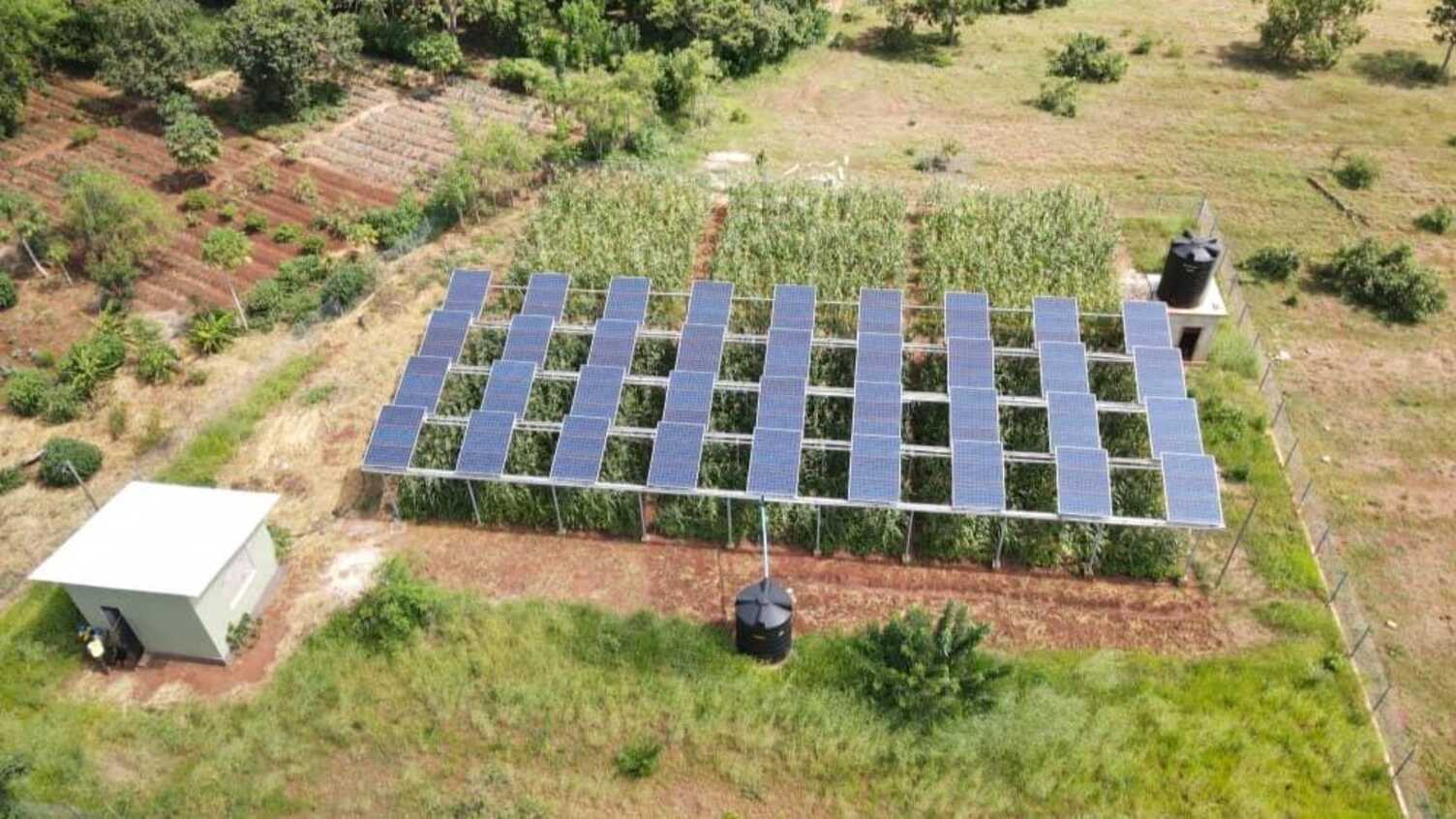
Aerial view of an off-grid agrivoltaic array shading maize on a farm in Kenya, with rainwater tanks
An off-grid agrivoltaic array shades maize and vegetables on a farm in Kenya, with rainwater tanks fed from the panels. It is one of the East African systems built and studied by the University of Sheffield and its partners.Photo: © University of Sheffield · sheffield.ac.uk

"By shading crops with solar panels, we created a microclimate that helped certain crops produce more, but they were also better able to survive heat waves and the shade helped conserve water, which is crucial in a region severely threatened by climate change."

Professor Sue Hartley, University of Sheffield[23]

The second is the Sahel and West Africa, where Fraunhofer ISE has taken its own science toward the conditions this analysis says are most favorable. Through a research project known as APV-MaGa, running from 2020 to 2023, the institute and a consortium of German, Malian and Gambian partners piloted integrated agrivoltaic systems in Mali and The Gambia, pairing solar generation with cropping and water management as a single triple-use system.[24] The economist Tim Krieger, who has led the project's economics work, is candid that the West African setting is hard: the region has "abundant sunshine and dry soils, in theory ideal conditions," but in practice the project ran into questions of land tenure, ownership of the modules and village acceptance, a reminder that agrivoltaics here is "far from being just a technological issue."[2] A 2024 systematic review of the West African evidence reaches a convergent conclusion, finding mutually reinforcing benefits across the region's water, energy and food needs.[25]

How much could fit? An honest answer separates what is measured from what is inferred. No one has published a measured agrivoltaic potential for these countries the way Fraunhofer has for Germany. What can be said rigorously is this: the land-efficiency results are not in dispute. Germany's farmland can host 500 gigawatts[18], and less than 1% of US farmland could carry a fifth of US electricity demand.[15] Sub-Saharan Africa has stronger sun than either[19] and a larger share of its workforce and land already in agriculture.[20] Applying the same land-efficiency logic to that base implies very large headroom, using a single-digit fraction of cropland. That last clause is an inference from transferable physics and land-use arithmetic, not a measured national figure, and it should carry exactly that weight. The economic content, however, is concrete: a technology that lets the same hectare keep its harvest and also generate power below the grid price[23] is not adding a second industry to the land, it is adding a second income to the people already on it.

VII · The Opportunity, South America

The Same Physics in a Different Geography


South America presents the same physics in a different geography, and again two regions stand out because they already have working systems. The first is Brazil's semi-arid Northeast, the Sertão, where the Caatinga endures some of the most variable rainfall in the country. There, a network of more than 40 Brazilian researchers, funded by the national research council CNPq and coordinated by the Pernambuco Agronomy Institute, built the country's first agrivoltaic system, Ecolume, at an agroecology school in Ibimirim, Pernambuco. The pilot pairs raised solar panels with an aquaponics bed and a chicken pen, reusing water and harvesting rain. In the project's simulations, the shaded system produced up to 70% more vegetables while lowering water demand, and the integrated water-recycling design cut irrigation water use by about 90%.[26]

The coordinator, climatologist Francis Lacerda, frames it as a development model: a single family-scale unit can feed about seven people and generate roughly 11,000 reais, about US$2,100, a year, on a pilot that cost around 20,000 reais, about US$3,750, to build.[26] The wider prize is land that is currently being cleared, since 46% of the Caatinga's native vegetation has already been lost; co-locating energy and food on degraded ground could relieve that pressure rather than add to it.[26]

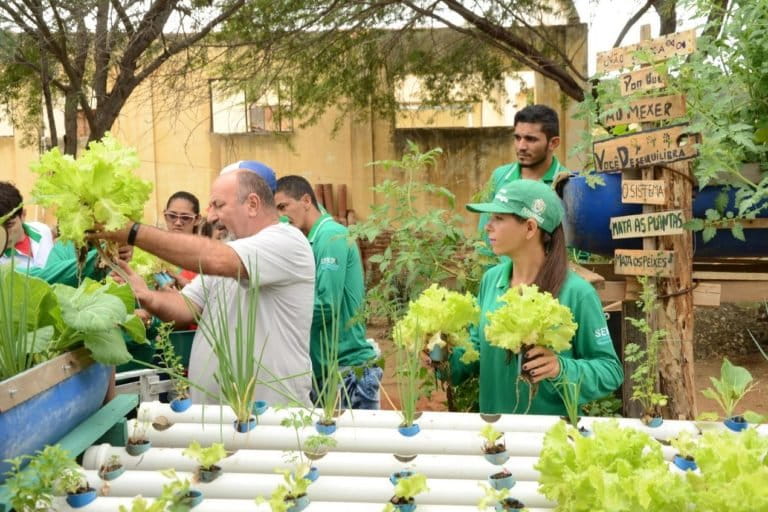
Students harvesting lettuce and herbs from the aquaponic beds of the Ecolume agrivoltaic system at the SERTA school in Pernambuco, Brazil
Students at the SERTA agroecology school in Pernambuco harvest lettuce and herbs from the aquaponic beds of the Ecolume system (SAVE), Brazil's first agrivoltaic installation, which pairs raised solar panels with food and water reuse.Photo: courtesy of Ecolume, via Mongabay · news.mongabay.com

The second is Chile, the country with arguably the best solar resource on Earth and an agricultural sector squeezed by a multiyear drought. In the central Maule region, researchers modeled a 100-kilowatt-peak vertical agrivoltaic installation in the area of Chanco and found water savings of up to 1,410 cubic meters per hectare, driven by reduced irradiation on the crop combined with the windbreak effect of the panel rows, while the vertical bifacial design left most of the field free for cultivation.[27] Farther north, the Atacama Desert offers some of the highest solar irradiance measured anywhere, with annual direct normal irradiation above 3,300 kilowatt-hours per square meter.[28] Chile spans the full agrivoltaic argument in one country: world-class generation, agriculture under genuine water stress, and a measured reduction in crop water demand when the two are combined.

VIII · Symbiosis

A Symbiosis of Food and Energy


The deepest thing agrivoltaics settles is the tension that has shadowed large-scale solar from the start: whether clean power and food must compete for the same ground. The evidence says they need not, and that single fact removes the assumption underneath a great deal of resistance to solar. Land was never the scarce input. Converting on the order of 1% of the world's agricultural land to solar would be enough to meet projected global electricity demand[30], and in the United States less than 1% of farmland could carry roughly a fifth of national electricity.[15] The ceiling was never the soil. It was grid connections, storage and capital, the very limits Fraunhofer found capping Germany's 500 gigawatts of potential.[18]

What that reframing unlocks is clearest not on a balance sheet but in a field. In the dry, sun-heavy places where the science works best, the same hectare that once forced a farmer to choose now pays twice over. A crop survives the heat wave it used to lose, because the panels blunt the midday sun.[12][13] The water bill falls by a third or more in exactly the seasons that decide whether a harvest lives.[9][11][27] And on land already being worked, a new current of electricity appears, or an income from selling it, without taking a single row out of production.[23][26]

This is why a technology invented in temperate Europe matters most where it was least expected to. Picture the arithmetic landing not on a grid map but on the roughly 600 million people in Sub-Saharan Africa who still have no electricity[21], in regions where farming is half of all work[20] and where women and girls lose hours of every day to carrying water.[22] The same panels that merely neaten a German field can, in the Sahel or Brazil's Sertão, protect the harvest, ease the water and bring the power, all at once, on ground that is already feeding families. It is food, water and energy security arriving together, from the same square meter, in the places that need all three and have so often been told they must pick only one.

The science, in the end, is no longer the hard part. The crop and the panels turn out to help each other: the shade protects the harvest, while the cooler, transpiring field beneath lifts the panels' own output, and a single hectare carries both. The old choice between food and power was never forced on us by nature. It was a habit of how we chose to build.

What stands between that promise and the field is no longer biology. It is economics and infrastructure: the cost of building higher, the wait for a grid connection, and the question of who finances the first systems in the places that need them most. That is exactly where this series goes next. If the opportunity is this large, why has so little of it been built? Part 2 takes up the barriers, and what it will take to clear them.

Sources

30 references · figures noted where a DOI or author list should be confirmed before publication

1International Energy Agency, energy sector ~three-quarters of global greenhouse-gas emissions (Net Zero by 2050 framing; consistent with Climate Watch / Our World in Data, ~73%). iea.org
2M. Bolze, interview with Max Trommsdorff & Tim Krieger, "Harvesting the Sun Twice." FRIAS, University of Freiburg, 19 Feb 2026. uni-freiburg.de
3Fraunhofer ISE, Agrivoltaics: A Guideline (English ed.), 2020. ise.fraunhofer.de
4Fraunhofer ISE, "Harvesting the Sun for Power and Produce" (land-use efficiency >60%), press release, 2017. ise.fraunhofer.de
5Dupraz, C., et al. "Combining solar photovoltaic panels and food crops for optimising land use." Renewable Energy 36(10), 2011. DOI 10.1016/j.renene.2011.03.005
6Weselek, A., et al. "Agrivoltaic system impacts on microclimate and yield of different crops." Agronomy for Sustainable Development 41:59, 2021. DOI 10.1007/s13593-021-00714-y
7Fraunhofer ISE, "Agrophotovoltaics: High Harvesting Yield in Hot Summer of 2018," press release, 12 Apr 2019. ise.fraunhofer.de
8Barron-Gafford, G.A., et al. "Agrivoltaics as a climate-smart and resilient solution for midday depression in photosynthesis." npj Sustainable Agriculture 3, 2025. DOI 10.1038/s44264-025-00073-1
9Marrou, H., et al. "Productivity and radiation use efficiency of lettuces grown in the partial shade of photovoltaic panels." European Journal of Agronomy 44, 2013.
10Hassanpour Adeh, E., Selker, J.S. & Higgins, C.W. "Remarkable agrivoltaic influence on soil moisture, micrometeorology and water-use efficiency." PLOS ONE 13(11), 2018.
11Warmann, E., Jenerette, G.D. & Barron-Gafford, G.A. "Agrivoltaic system design tools..." Environmental Research Letters 19:034046, 2024. DOI 10.1088/1748-9326/ad2ab8
12Barron-Gafford, G.A., et al. "Agrivoltaics provide mutual benefits across the food-energy-water nexus in drylands." Nature Sustainability 2(9), 2019. DOI 10.1038/s41893-019-0364-5
13Sturchio, M. & Knapp, A.K., et al. (Cornell & Colorado State). Agrivoltaics-and-grassland-productivity study, Environmental Research Letters, 2025. DOI 10.1088/1748-9326/add94d
14NREL, InSPIRE project and "The 5 Cs of Agrivoltaic Success Factors in the United States." nrel.gov; research-hub.nrel.gov
15Proctor, K.W., Murthy, G.S. & Higgins, C.W. "Agrivoltaics Align with Green New Deal Goals..." Sustainability 13(1):137, 2020. DOI 10.3390/su13010137
16Rouini, N., et al. "High-shade dryland agrivoltaic conditions... zucchini." Frontiers in Sustainable Food Systems 9, 2025. DOI 10.3389/fsufs.2025.1686773
17Horowitz, K., et al. "Capital Costs for Dual-Use Photovoltaic Installations: 2020 Benchmark." NREL/TP-6A20-77811, 2020. DOI 10.2172/1756713
18Fraunhofer ISE, Germany's agrivoltaic potential (up to 500 GW; Hauger quotes), 2025. Reported by S. Enkhardt, pv magazine, 8 Jul 2025
19International Energy Agency, Africa Energy Outlook 2022 (~60% of best solar resource; ~1% of installed PV). iea.org
20World Bank / ILO, "Employment in agriculture (% of total), Sub-Saharan Africa," SL.AGR.EMPL.ZS (~one-half). data.worldbank.org
21International Energy Agency, Financing Electricity Access in Africa (2025) & SDG7 tracking (~600M, ~47%, in 2024). iea.org
22WHO/UNICEF Joint Monitoring Programme, Progress on Household Drinking Water, Sanitation and Hygiene 2000-2024, 2025. who.int
23Randle-Boggis, R., Hartley, S. (senior author), et al. (Univ. Sheffield, with CIFOR-ICRAF, SAT, Latia, Univ. Arizona). "Agrivoltaics in East Africa," Renewable and Sustainable Energy Reviews, 2024. ScienceDirect S1364032124007925; sheffield.ac.uk
24Fraunhofer ISE, "APV-MaGa: Agrivoltaics for Mali and The Gambia," research project (BMBF), Aug 2020-Dec 2023. ise.fraunhofer.de
25"Agrivoltaic systems... water-energy-food-environment nexus in West Africa: A systematic review." Energy Research & Social Science, 2024. ScienceDirect S2214629624003281. (Confirm volume/DOI/authors before publication.)
26Lacerda, F.F., et al. "O Projeto Ecolume..." Revista Fitos 14(2), 2020. DOI 10.32712/2446-4775.2020.941. Reported by M. Martinez, Mongabay, 5 Jul 2022
27"Vertical agrivoltaics... a case study in the area of Chanco, Chile." Sustainable Energy Technologies and Assessments 60:103425, 2023. ScienceDirect S2213138823004186. (Confirm author list/DOI.)
28Solar resource assessment of the Atacama Desert (DNI >3,300 kWh/m2), Renewable Energy, 2023. ScienceDirect S0960148123009059
29Rutgers Agrivoltaics Program (RAP), NJ Agricultural Experiment Station; Dave Specca. Three-site NJ network; first-year soybean gains; "Solar Farm of 2025." agrivoltaics.rutgers.edu (preliminary single-season data)
30Adeh, E.H., Good, S.P., Calaf, M. & Higgins, C.W. "Solar PV Power Potential is Greatest Over Croplands." Scientific Reports 9:11442, 2019. DOI 10.1038/s41598-019-47803-3

Vera Meridian

Want to talk through agrivoltaics, or are you thinking about developing a project of your own?

Get in touch →