Photo: Lana Kravchenko / Pexels
Vera Meridian Insights

Article 6 and the Case for Ethical Capitalism


There is a version of capitalism in which the profit motive and human need point in the same direction, not by accident, and not by charity, but by design. Article 6 of the Paris Agreement is the first mechanism at global scale that makes it possible. This is the case for why, and an honest account of how little of it has been built.

By Justin Miller · June 15, 2026 · 26 min read · 40 sources

← Back to Insights I. The Tension

The Gap Between Agreement and Action


A primer, for anyone new to this A carbon credit is a certificate representing one tonne of carbon dioxide either kept out of the atmosphere or removed from it, by replacing a diesel generator with solar, or by ending the need to burn wood. A party that reduces emissions earns credits; a party that needs to account for emissions buys them. Article 6 is the section of the 2015 Paris Agreement that lets two governments do this with each other: one country funds emissions reductions inside another and counts the result toward its own national climate target. The traded unit is called an Internationally Transferred Mitigation Outcome, or ITMO. Hold those three terms, credit, Article 6, ITMO, and the rest follows.

In December 2023, Switzerland and Thailand completed the first fully realised transaction under Article 6.2 of the Paris Agreement: 1,916 emissions-reduction units, financing the conversion of Bangkok's diesel bus fleet to electric. For nearly two years it stood almost alone. As of April 2025, analysts at Columbia University's Center on Global Energy Policy counted it as the only ITMO transfer fully completed, against more than ninety bilateral agreements already signed.[1]

Then the picture began to move. In June 2025, Norway and Switzerland completed the first transfer of carbon-removal ITMOs.[2] In July, Ghana and Switzerland completed the first issuance of ITMOs for a mitigation activity anywhere in Africa: nearly 12,000 units from a rural clean-cooking programme, purchased by Switzerland's KliK Foundation.[3] That October, Japan and Thailand completed their first transfer under the Joint Crediting Mechanism, and Japan and the Maldives followed in December.[4] That made five completed transfers in 2025 where eighteen months earlier there had been just one: Switzerland–Thailand, Norway–Switzerland, Ghana–Switzerland, Japan–Thailand, and Japan–Maldives. By March 2026, the tally had climbed past 106 bilateral arrangements spanning 53 host countries, with 169 projects in implementation.[5]

Hold those two facts together, because the whole argument of this essay lives in the space between them. On one side, a mechanism whose completed transactions still total a few tens of thousands of tonnes. A rounding error against the need. On the other, a transaction count that went from one to five in eighteen months, an agreement pipeline that keeps thickening, and sovereign governments committing real money. A skeptic reads the first fact and calls the mechanism theatre. An enthusiast reads the second and declares the revolution underway. Both are wrong in the same way: they mistake the readiness of the architecture for the readiness of the market. The rules are finished. The deals are not.

Capitalism is not, on its own, an ethical enterprise. It is an engine for allocating capital toward return, indifferent by design to who benefits and who is left out. That is exactly why Article 6 is worth this much attention: it may be the first example of ethical capitalism at global scale, a case where the profit motive and human benefit are aligned not by charity bolted on afterward, but by the structure of the mechanism itself.

The way it does this is by changing what is profitable to build. Consider the kind of project that has never made commercial sense: clean water for a village that cannot pay for it, power for a region too poor to be a market, food and electricity for communities whose governments cannot provide either. For a private developer these have always been someone else's problem, the domain of aid and charity, because there was no revenue in them. Article 6 changes that calculation. By assigning a market price to the emissions reductions these projects create, it gives a for-profit developer a real, bankable reason to build the things they would not previously have even considered.

That is the lever: a mechanism that can make it rational for private capital to flow toward the people who need it most and can afford it least, not as philanthropy, but as a returns-driven decision. The infrastructure that charity could only ever build once, and watch fail when the funding ran out, becomes infrastructure that pays to sustain itself. Profit and human good, for once, point in the same direction.

This is also where Article 6 breaks decisively from the voluntary carbon market that preceded it, and the difference comes down to who stands behind the money. Voluntary credits were bought by corporations whose commitment could evaporate with a change in strategy or a bad quarter, which made the revenue too uncertain to finance a project against. Article 6 puts sovereign governments on the other side of the deal. When a developer secures an offtake agreement from Sweden, Norway, or Singapore (some of the most creditworthy nations on earth), that contract is not a hopeful projection. It is a bankable instrument, backed by a sovereign balance sheet and a binding treaty obligation, something a developer can take to a lender to raise the capital to build. The strength of the mechanism is, quite literally, the financial strength of the countries participating in it.

The mechanism is built. The corresponding adjustment works, the buyers are creditworthy, the methodologies exist, and the capital is waiting on the other side of a bankable contract. What is left is not invention. It is execution. The architecture is finished; the market is not, and everything that follows is about closing the distance between them.

II. The Mechanism

Why a Sovereign-Authorised Tonne Is Worth More Than a Voluntary One


The voluntary carbon market, the older, company-driven market you may have seen criticised in the press, had one fatal structural flaw: nothing in its architecture stopped the same tonne of avoided emissions from being claimed twice. A company could buy a credit and claim the reduction, while the country the project sat in also counted that reduction toward its national target. Both claims looked valid; both could not be true. Add the documented overcrediting in categories like cookstoves and avoided deforestation, and the result was a market where the link between the money and the atmosphere became impossible to trust.

That erosion of trust had a financial consequence, and it was brutal. In 2023 the voluntary market contracted by 56% in a single year, its total value falling to around $723 million, with roughly $1.1 billion in finance for nature-based projects disappearing as corporate buyers retreated amid greenwashing concerns.[6] Average prices sat near $6.50 a tonne and swung with sentiment. For a developer, that is close to impossible to build against: no lender will underwrite a 15-year asset on a revenue line set by a handful of discretionary buyers who can walk away at will. The voluntary market could fund what was already cheap and quick to build. It could not reliably finance hard infrastructure in the places that needed it most.

Article 6.2 addresses the integrity half of that problem with one rule, the corresponding adjustment. When a host country authorises and transfers an ITMO, it must add that tonne back onto its own national emissions ledger at the same moment the buying country subtracts it from theirs.[7] It is double-entry bookkeeping imposed on the atmosphere: the reduction is counted once, by one party, and the act of selling it is the act of surrendering the right to count it yourself. This is not a verification tweak layered on the old market. It is a different accounting system, and it is the reason a sovereign-authorised tonne is a structurally different, and more valuable, asset than a voluntary one.

THE OLD FLAW — VOLUNTARY MARKET HOST COUNTRY counts −1 tonne ✓ BUYER / COMPANY counts −1 tonne ✓ same tonne Two claims. One tonne. Both can't be true. THE FIX — ARTICLE 6.2 CORRESPONDING ADJUSTMENT HOST COUNTRY +1 tonne added back to ledger ITMO + payment BUYING COUNTRY −1 tonne counted toward NDC NET: −1 TONNE Counted once. The sale is the surrender.

Fig. 1 — The corresponding adjustment turns a contestable claim into double-entry bookkeeping. The host country's "+1" is precisely what the buyer pays a premium for. Source: UNFCCC Article 6 framework.[7]

That premium shows up in price. In the first public ITMO auction, run by Carbon Trade eXchange in July 2024, Malawi-authorised cookstove credits cleared at a floor of $10 per tonne, while equivalent voluntary credits without a government authorisation traded near $3.80. Later assessments have valued authorised cookstove credits several times higher still.[8] One honest caveat: these are cookstove-specific figures from an early, thin market, not a settled price curve for all ITMOs. But the direction is unambiguous. Buyers with binding legal obligations are paying materially more for the corresponding-adjustment guarantee.

And those buyers are governments, which is what makes the demand durable. It is tied to law and treaty, not to corporate marketing budgets that vanish in a downturn. Singapore's carbon tax sits at S$45 per tonne for 2026 and 2027, rising toward S$50 to 80 by 2030, and Singapore lets companies offset up to 5% of taxable emissions with Article 6-compliant credits; by early 2026 it had signed more bilateral cooperation agreements than any other country.[9] Japan's Joint Crediting Mechanism now spans 223 active projects across 24 countries, with bilateral agreements covering 32.[4] Sweden's Energy Agency runs a dedicated Article 6 programme funded at roughly €126 million through 2032.[10] Norway has committed on the order of $740 million and rising, toward as much as $1.5 billion, to purchase up to 15 million credits.[11] Much of this now flows through shared infrastructure: the Global Green Growth Institute's Carbon Transaction Facility, launched in October 2024, pools a Norwegian pledge of up to $100 million and a Swedish fund of $28.5 million to transact ITMOs on behalf of host countries.[12]

Sovereign NDC buyers are not the only source of compliance demand, either. CORSIA, the United Nations scheme that obliges international airlines to offset growth in their emissions, now requires the credits airlines surrender to carry host-country authorisation and a corresponding adjustment under Article 6. Its second phase, running from 2027, applies to almost all major aviation states, and participation has grown to 130 countries. That places a second stream of binding, compliance-grade demand behind exactly the high-integrity units this market produces, the same units that finance the water systems and solar plants this essay is about. (The precise scale of that aviation demand is genuinely uncertain: CORSIA prices have been volatile, and the European Commission's 2026 review of how the scheme interacts with the EU Emissions Trading System could reshape it significantly. That is a conversation for another essay. The structural point stands: a second category of buyer, bound by compliance rather than goodwill, now wants the same corresponding-adjustment-backed unit.)[13]

So what does all of this actually mean? It means the demand side of this market is no longer hypothetical. It is sovereign governments, with legally binding targets and published budgets, actively looking for verified tonnes to buy. That is the precondition for everything that follows. A mechanism that merely allowed ethical outcomes would be a curiosity; what makes Article 6 consequential is that real, durable money now stands on the demand side waiting for supply. The question is no longer whether anyone will pay for emissions reductions in the developing world. Governments have answered that. The question is whether the projects that would produce those reductions, and transform lives in the process, actually get built. That is a question about supply, about structuring, and about people willing to do the work. It is the question of whether the ethical capitalism this mechanism makes possible becomes real.

III. The Ethical Architecture

What Makes It Ethical Is the Commodification Itself


Here is the part that is easy to get wrong, so let us be precise about where the ethics actually live.

The conventional worry about a mechanism like this is that the host country will not get paid enough, that wealthy buyers will extract cheap tonnes from poor nations. That framing misunderstands how Article 6 works, and it is worth walking through what participation actually requires, because the process itself answers the objection.

Before a single credit changes hands, a host country must establish a national carbon framework. That framework sets the legal authority to authorise transfers, names a designated national authority to administer them, and defines which projects qualify. It also fixes how the country accounts for its own climate target so that selling a tonne does not undermine its national commitments, and how revenue and benefits are shared. The country must be able to track what it sells and apply the corresponding adjustment to its own ledger. A buying country, in parallel, must stand up its own authority to approve purchases and account for the units it acquires. None of this is automatic, and only a limited number of countries have so far put the full apparatus in place. This is part of why the pipeline of agreements so badly outruns the pipeline of completed transfers: building the framework is itself a substantial undertaking.

The decisive point is who holds the pen. The host country writes that framework. It sets its own terms, its own revenue shares, its own rules for who may develop and on what conditions. It decides what a fair price is and whether to authorise a given deal at all. The host government is not a victim of this market. It is the author of its own position within it, and the gatekeeper of its own resources.

The actual mechanism, and the actual source of its ethical character, is something more interesting: commodification. For the first time, the emissions reduction created by giving someone clean water has a market value. That changes the economics of doing good from impossible to viable. Consider a case. In a rural community, families burn wood and charcoal to boil river water so it is safe to drink. A developer who installs a solar-powered clean-water system and gives that water away for free has, historically, had no business reason to do so, because there is no revenue in serving people who cannot pay. Under Article 6, that same act now generates verified, sellable emissions reductions: the burning stops, the avoided emissions are real, and a sovereign buyer will pay for them. The good deed becomes a financeable transaction. That's what makes it capitalism, not generosity and not subsidy in the charitable sense, and the alignment of profit with human benefit is what makes it ethical.

What the corresponding adjustment cannot do is guarantee that any of this gets built. It makes the carbon honest; it does not make the deal happen. That still takes developers willing to enter these markets, and the structuring work of turning an authorised framework into a financed project. But the decisive shift has already occurred. The water is what reaches the village, yet it is the emissions reduction behind it that creates the commodity, and by giving that reduction a price, Article 6 has made it profitable to serve people the market always ignored. The commodity is what pulls the developer in. Everything after it is execution.

This is where the obvious objection arrives. If developers are chasing profit, what stops them from capturing all the value and leaving host countries and communities with scraps? The mechanism's own structure answers it. A developer cannot monetise a single credit unless the infrastructure is actually built and actually used, because the verified emissions reduction does not exist otherwise. The community's win is therefore not charity layered on top of the deal; it is the precondition of the deal. They receive infrastructure they could never have afforded, that their own government had not provided, and the developer earns nothing until they have it. The host country, meanwhile, sets the terms: it takes a defined share of the carbon revenue, and as a market matures and a single authority approves dozens of projects a year, that share could compound into a serious public revenue stream of its own.

The developer does keep the majority of the profit. That is not a flaw in the model. It is the model. The private sector is being paid to solve problems that aid and charity never could, and the payment is precisely what makes the solving happen. A developer who is well compensated for delivering clean water to people who could not buy it is not a moral compromise. It is the entire point.

IV. In Practice

Use Cases for Article 6


These three project types show what the mechanism looks like in practice.

Is the human need real?  ·  Does the technology work?  ·  Is Article 6 actually financing it yet?

In each case, the need and the technology are largely settled. What is still unproven at scale is the financing.

Clean water is the purest test of financing infrastructure for people who cannot pay.
Agrivoltaics is the case where one installation stacks several benefits and several revenue streams.
Utility-scale solar is the type closest to bankable today, which makes it the clearest place to show exactly what carbon revenue adds.

Case 01 of 03 · The Purest Test

Solar-Powered Clean Water

Clean water is the purest test of the thesis, because the people who need it most can pay the least. An ordinary market never builds it, and a charity that does usually cannot keep it running. Water nonprofits tend to fail in one repeating way: the project lasts only as long as the grant or the donations that funded it, and when the money stops the infrastructure stops with it. Capital arrives, the system is installed, and within a few years a pump fails or a membrane fouls, the money is gone, and the infrastructure goes with it. A project financed against carbon revenue is built to last, because the payments only continue while the system keeps delivering water people actually use.
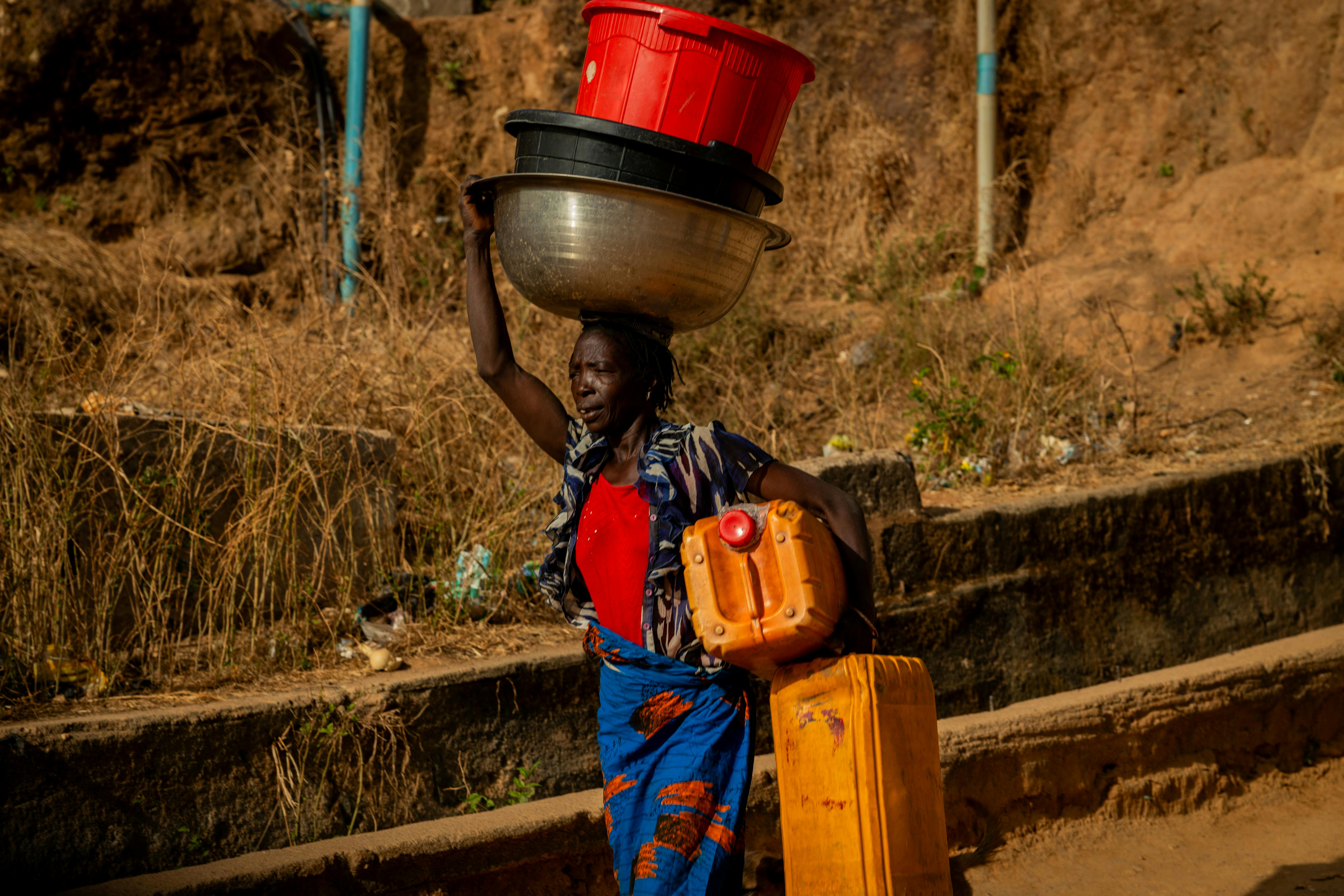
A woman carrying water containers in a dry, arid setting in Sub-Saharan Africa

The burden of collecting water falls overwhelmingly on women and girls. Across Sub-Saharan Africa it consumes an estimated 40 billion hours a year. Photo: Alex Gamaliel / Pexels

The need is severe and well documented. Roughly two billion people worldwide lack safely managed drinking water.[14] The World Health Organization estimates that around 1.4 million deaths a year are associated with unsafe water, sanitation, and hygiene, most of them preventable.[15] In the African region alone, unsafe water and sanitation are linked to roughly 842,000 diarrhoeal deaths a year, including about 361,000 children under five.[16]

The burden of fetching that water falls overwhelmingly on women and girls, and the scale of it is hard to overstate. Across Sub-Saharan Africa, women and girls spend an estimated 40 billion hours a year collecting water, which UN Women describes as equivalent to a full year of labour by the entire workforce of France.[17] In Asia and Africa, women walk an average of six kilometres a day to collect it.[18] A single round trip in rural Sub-Saharan Africa averages 33 minutes and runs well over an hour in countries such as Mauritania and Somalia.[19] The division of labour is starkly unequal: in nearly 80% of households without water on premises, women and girls are the primary collectors, and in Malawi the UN found women spent 54 minutes per trip against just 6 minutes for men.[19] The consequences compound. Time spent hauling water is time taken from school and paid work; the loads cause chronic back and joint injury; and the long journeys to distant sources expose women and girls to documented risk of physical and sexual violence.[20] Providing water at the household or village level does not just prevent disease. It returns time, safety, and opportunity to the people who currently pay for its absence.

A clean-water installation is a full infrastructure system, not a single device. A solar array powers a borehole pump or a purification unit, typically reverse osmosis or ultrafiltration, which feeds storage, water kiosks, and a distribution network of transmission and reticulation piping that carries safe water to where people live. The hard part is not building it. It is keeping it running for years, and that is exactly what a carbon revenue stream is suited to support.

The carbon logic here is direct, and it rests on something real rather than hypothetical. These projects target communities that are already cutting and burning wood or charcoal to boil their water and make it safe to drink. Providing clean water removes the need to burn biomass. The avoided deforestation and combustion are observable and measurable, which means the emissions reductions are genuine, not assumed. The good done and the carbon counted become the same act.

~2B
People worldwide without safely managed drinking water[14]
~1.4M
Deaths a year associated with unsafe water, sanitation & hygiene (WHO)[15]
40B hrs
Spent collecting water yearly in Sub-Saharan Africa, by women & girls[17]
~361K
Children under five lost yearly to diarrhoeal disease in Africa[16]

Case 02 of 03 · The Multi-Stream Case

Agrivoltaics

What it is. Agrivoltaics is the deliberate co-location of solar generation and agriculture on one piece of land, with panels raised and spaced so crops grow in the partial shade beneath them. Instead of choosing between a field and a solar farm, the same hectare does both. It is not a tidy compromise but a genuine synergy. In hot, dry, high-sun regions the panels shelter crops from heat and evaporative stress, while the crops' transpiration cools the panels and lifts their electrical output. Each makes the other work better.
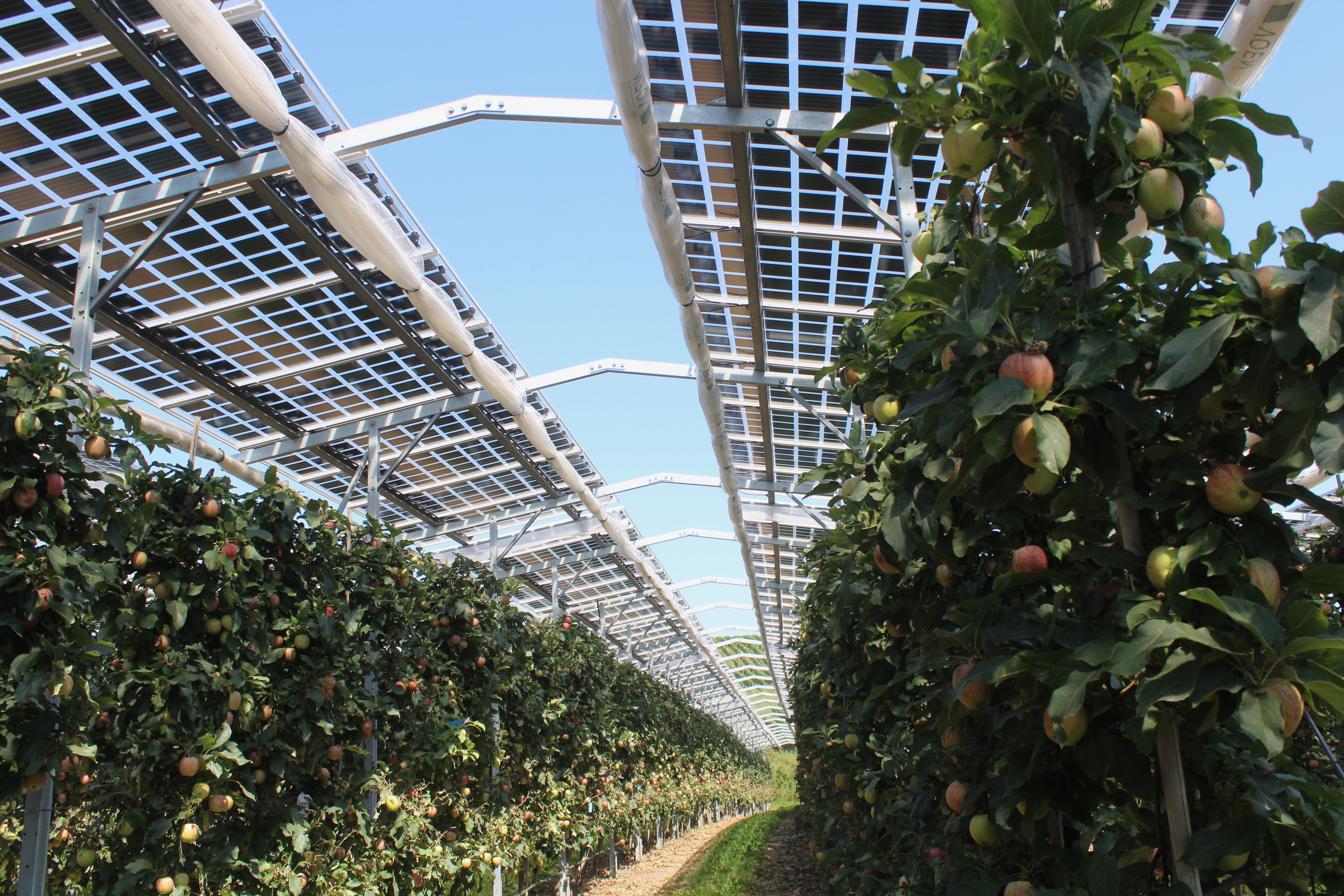
Rows of apple trees growing in fruit beneath elevated solar panels

Apples ripening under elevated panels. The same hectare produces food and power at once, and uses less water doing it. © Fraunhofer ISE

The controlled science. Controlled studies bear this out. At the University of Arizona's Biosphere 2, Barron-Gafford and colleagues found chiltepin peppers produced three times the fruit under the panels and tomatoes twice the fruit, with jalapeños grown on 65% less transpirational water and soil moisture about 15% higher than in the unshaded plot.[21] The effect ran both ways: the crops cooled the panels enough to raise their electrical efficiency.

The field evidence from Africa. The more important question is whether this holds in the Global South, and recent African field data says it does. A University of Sheffield team published the first such study for Sub-Saharan Africa in 2024, running two operational systems: a 36.6 kW off-grid array in Morogoro, Tanzania, and a 62.1 kW grid-tied array in Isinya, Kenya. Maize, Swiss chard, and beans grew better in the partial shade than in open fields, used less irrigation water, survived heat waves more reliably, and the systems generated electricity at below the cost of grid power.[22] A separate 2024 systematic review of agrivoltaics across West Africa, drawing on 33 studies, found water-use efficiency improvements of 20% to 47% and air and soil temperature reductions of 1 to 4 degrees Celsius, with the strongest gains precisely in the water-scarce conditions that define much of the region.[23]

The scale of the opportunity. Germany's Fraunhofer Institute for Solar Energy Systems, the leading European authority on the technology, has documented land-use efficiency well above 100% in its trials, and in a 2025 national assessment estimated Germany's technical agrivoltaic potential at up to 500 GW on suitable land, more than double the country's entire 2030 solar target.[24] That figure is the one to sit with, because its implication for the Global South is enormous.

🌾
2–3×
Crop yield under panels in Arizona trials: tomato 2×, chiltepin pepper 3×[21]
💧
20–47%
Water-use efficiency gain across a 33-study West Africa review[23]
500 GW
Germany's agrivoltaic potential, more than 2× its 2030 solar target (Fraunhofer ISE)[24]

LER, the Land Equivalent Ratio, is the standard measure here. A value above 1.0 means one dual-use hectare out-produces the same land split into a separate field and a separate solar farm. Well-designed agrivoltaic systems consistently exceed it.

What this means for the Global South. If temperate, often cloudy Germany can find 500 GW of agrivoltaic potential, the implication for the sun-rich Global South is staggering, and it points exactly where the need is greatest. The conditions where agrivoltaics performs best, namely intense sun, scarce water, and heat-stressed agriculture, are not the conditions of central Europe. They are the conditions of West Africa and the Sahel almost exactly. A technology refined in Tucson and Freiburg and now proven in Tanzania and Kenya has its natural home in the African drylands, where roughly 600 million people lack reliable electricity and agriculture is the largest employer. Co-locating food and power there is not a luxury. It is the single most efficient use of land, sun, and capital at once: a farmer keeps farming, the same hectare generates power, and water use falls.

Why the carbon logic is unusually strong here. Most renewable projects generate a single carbon revenue stream. An agrivoltaic installation can generate several from the same footprint, which is what makes it such a natural fit for Article 6 finance. The first and largest stream is the solar generation itself, displacing diesel or a fossil-heavy grid. A second comes from reduced diesel where the system powers irrigation pumping that would otherwise run on a generator. A third becomes available as Article 6.4's land-sector methodologies mature: where panels sit on degraded land and the protected microclimate restores soil and vegetation, those soil-carbon and restoration gains may themselves be creditable. Each stream rests on a different, independently verifiable physical change, so they can be quantified and sold without double-counting one against another.

The significance of stacking is financial, not merely additive. More creditable streams from one footprint means carbon revenue can carry a larger share of the project's economics, which lowers the tariff the project must charge for power and food to remain viable. That matters enormously in markets where customers cannot absorb cost-reflective prices. A single agrivoltaic hectare can, in effect, be paid four ways at once: for the electricity it sells, for the food it grows, for the water it conserves, and for the carbon it abates. Few infrastructure types in the developing world have that many independent reasons to be financed, and that is exactly the quality that turns an unbankable project into a bankable one.

Case 03 of 03 · The Bankability Case

Utility-Scale Solar

The problem, stated plainly. The electricity gap in Africa is the starkest in the world.

600 million people in Africa live without electricity, close to half the continent, and 98% of them in Sub-Saharan Africa.[25]
Only about 11 million people gained access between 2023 and 2024, far below the pace needed for universal access.[25]
The continent holds an estimated 60% of the world's best solar resource, more than 10 TW of potential, yet attracts a fraction of the investment it needs.[26]
Universal access by 2035 requires roughly $15 billion a year, yet under $2.5 billion was committed for new Sub-Saharan connections in 2023.[27]
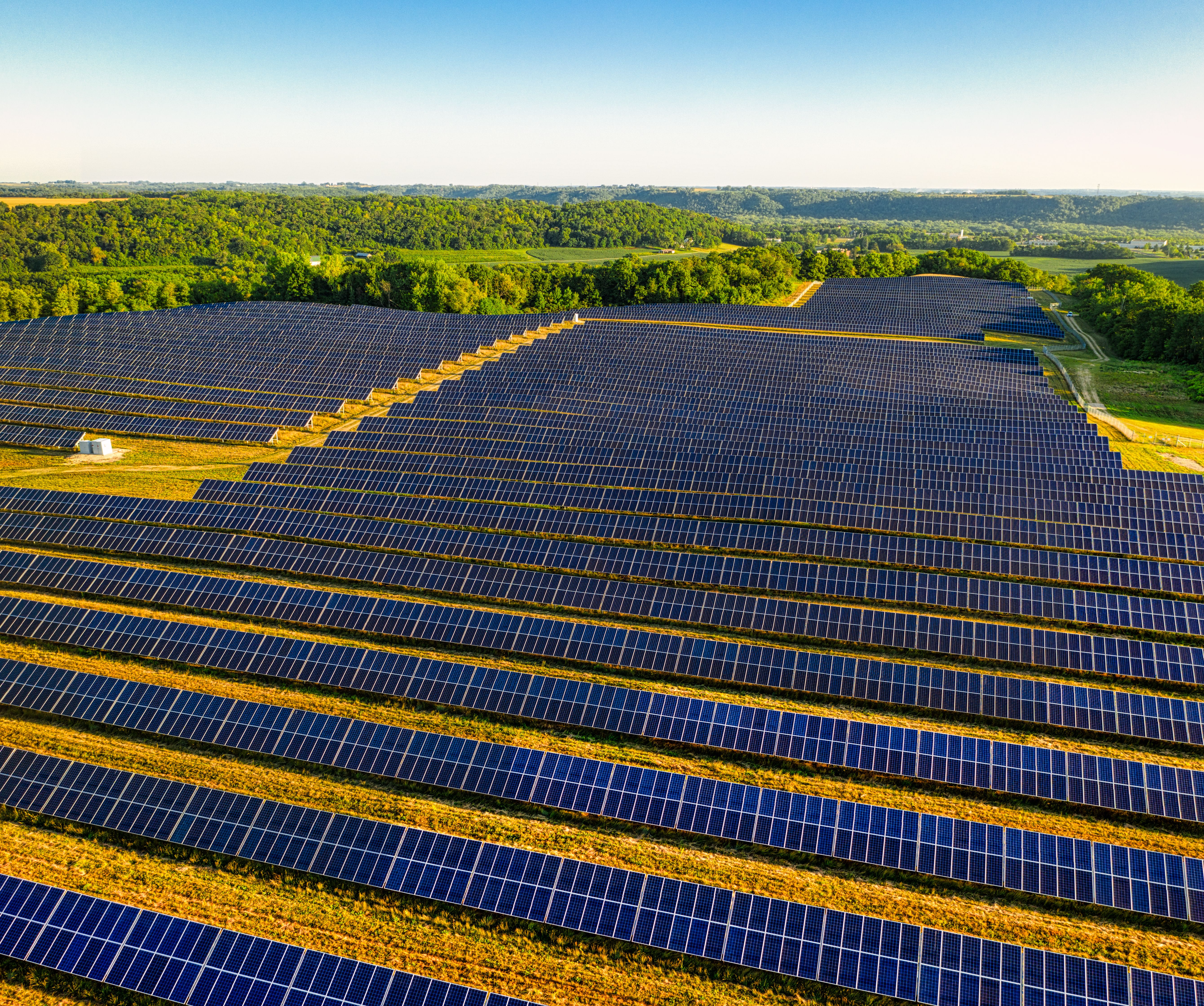
Aerial view of a large utility-scale solar array set among fields and hills

Utility-scale solar. The resource is abundant; the binding constraint is the grid that has to carry the power and the capital that has to build it. Photo: Tom Fisk / Pexels

Why these projects are hard to build. The capital gap is real, but it is not the only obstacle, and naming the others matters because they are where projects actually die. The African Solar Industry Association's 2026 outlook captures the shift bluntly: the continent announced about 40 GW of new solar projects in 2024 but installed only around 2.5 GW. The binding constraint is no longer policy or even capital. It is execution.[28] The recurring bottlenecks include:

01
Grid access and weak transmission

A solar plant is only as deliverable as the grid's capacity to absorb and move its power. Many national grids are too small or too weak to host large plants. Namibia's NamPower, for instance, has already hit its saturation cap for intermittent renewables, and outside South Africa and Nigeria few regional grids can host gigawatt-scale solar.[29]

02
Substation siting and transmission build-out

Where capacity is missing, the developer must fund substation upgrades or new transmission lines, costs that can sink a project's economics on their own.

03
Land acquisition and tenure

Securing clear, uncontested title to a large contiguous site is slow and legally fraught where land ownership is informal or disputed.[29]

04
Permitting and impact assessments

Environmental and social impact assessments and multi-agency permitting routinely add months or years to a project timeline.

05
Offtaker risk and long lead times

Many state utilities are weak counterparties, and lenders price that risk heavily. From concept to commercial operation commonly runs four to six years in Sub-Saharan Africa, with a high cost of capital throughout.[29]

What carbon revenue does about it. Here the argument becomes arithmetic, and it can be shown on real numbers. In April 2026, Zambia launched a 300 MW solar-plus-storage tender in partnership with Norway, with the national utility ZESCO as offtaker, requiring developers to calculate emission reductions using Zambia's official grid emission factor of 0.4029 tCO₂ per MWh.[30] Take a representative 100 MW plant in that programme. At roughly a 21% capacity factor it generates on the order of 184,000 MWh a year, which at 0.4029 displaces about 74,000 tonnes of CO₂ annually.

ILLUSTRATIVE MODEL — UNLEVERED IRR, ~100 MW SOLAR (FIGURES INDICATIVE) BANKABILITY THRESHOLD · ~12.5% ~8% POWER SALES ALONE (PPA) below threshold — capital looks elsewhere + carbon ARTICLE 6 ITMO ~74,000 tCO₂/yr ~13% BANKABLE PROJECT clears threshold — gets built

Fig. 2 — Illustrative; IRR figures are indicative, not from a specific financial model. Many utility-scale solar projects in frontier grids pencil out below the unlevered return investors require. The ITMO revenue bridges that gap. Grid factor and programme: Zambia 300 MW solar-storage tender, 0.4029 tCO₂/MWh.[30]

Sold under an Article 6 offtake, that carbon revenue does two things a power purchase agreement alone cannot. First, it lifts the project's unlevered return across the threshold investors require, turning a marginal IRR into a bankable one. Second, and less obvious, it can fund the grid interconnection work that frontier projects must so often pay for themselves: the substation construction and upgrades, the transmission and distribution build-out, the medium- and high-voltage lines needed to evacuate power from plant to load. These interconnection costs routinely determine whether a project is viable at all. Carbon revenue, structured into the capital stack, can absorb them. It is not a marginal sweetener on the returns. It can pay for the physical infrastructure that makes the plant deliverable in the first place.

The flywheel. What happens after one project clears the threshold is the part that compounds. Once a host country sees a single Article 6 solar plant reach financial close, it has a template: a published grid emission factor, a tested benefit-sharing structure, a buyer relationship, and a financing precedent. The second project is faster and the tenth is routine. But the flywheel is more than speed. It aligns three parties who do not usually share an interest. The host country gains generation, grid infrastructure, and carbon revenue. The developer earns a viable return on a project that otherwise would not exist. And the utility, ZESCO in this case, receives both the power and the transmission upgrades the carbon revenue helped fund, strengthening the grid for everyone downstream of it. That last point is the one that matters most. Carbon revenue does not just finance a single power plant. It can finance the public backbone, the substations and lines, that carry reliable electricity to rural communities far beyond the project fence. That is the difference between selling one plant's output and building a region's capacity to electrify itself.

600M
People in Africa without electricity, 98% in Sub-Saharan Africa[25]
$15B/yr
Needed for universal African electricity access by 2035 (IEA)[27]
~20 GW
Total solar installed across all of Africa by 2025, against 10 TW of potential[26]
60%
Of the world's best solar resource sits in Africa, largely uncaptured[26]
Where the Need Is Greatest

Three Projects Ready to Scale


The three cases above are where the argument is clearest, but they are not where it ends.

The project types below carry some of the largest human needs in the developing world. Each has proven harder to finance honestly than its proponents first assumed. That difficulty is not a reason to avoid them. It is the reason they need a mechanism with Article 6's rigor, and the reason they need developers and advisors willing to do the work properly.

The Largest Need, and the Cautionary Tale

Clean Cooking

No project type carries a larger human toll than the absence of clean cooking. Roughly a billion people in Sub-Saharan Africa still cook over wood, charcoal, and other solid fuels.

The WHO attributes on the order of 2.9 million premature deaths a year worldwide to household air pollution, about 600,000 of them in Sub-Saharan Africa, overwhelmingly women and children.[31] The IEA estimates universal clean cooking in the region could avoid roughly 900 million tonnes of CO₂-equivalent a year by 2030.[31] By need alone, it should be the flagship use of carbon finance. Instead it became the sector's cautionary tale: clean cooking was the fastest-growing offset type in the voluntary market, and it was also among the most abused.

A 2024 University of California, Berkeley study published in Nature Sustainability concluded that cookstove credits had been over-issued by an average factor of roughly nine, driven by inflated baselines, optimistic assumptions about how often stoves were actually used, and weak monitoring.[32] Separate analysis put over-crediting in some markets far higher, and one major developer admitted to a fraud of around $250 million after U.S. regulatory charges.[33] The response was a market correction: the Integrity Council for the Voluntary Carbon Market disqualified the legacy methodologies behind roughly two-thirds of cookstove supply, and issuance fell sharply.[34] This is the clearest example of how the voluntary market squandered a genuine need through bad measurement.

The solution is not to abandon clean cooking. It is to measure it honestly, and the credible path forward is already emerging: stoves fitted with sensors and SIM cards that report actual usage rather than assuming it, paired with conservative baselines and independent verification.[34] Under that standard, and especially under the sovereign discipline of Article 6, where a buyer government's reputation is attached to the result, clean cooking can become what it should have been from the start. The need is the largest in the field. The technology and the data tools now exist. What it requires is developers willing to credit only what they can prove.

The Answer for the Unreachable, Starved of Debt

Mini-Grids

For the hundreds of millions of rural people a central grid will never reach economically, a self-contained solar-and-storage mini-grid is the most viable answer. The IEA's universal-access pathway envisions roughly a third of required investment flowing to them.[27]

The need is not in question. The financing is.

Mini-grid developers struggle to raise debt more than almost any other category, because their customers are dispersed, low-income, and individually tiny, which makes projected revenues look risky and expensive to underwrite. A lender looking at a few thousand rural connections sees collection risk and currency risk, not a bankable asset. That is the specific reason mini-grid deployment has lagged so far behind the need.

A carbon offtake is unusually well suited to break that logjam. A predictable, hard-currency, sovereign-backed payment for verified emissions reductions, layered on top of modest local tariffs, gives a lender the creditworthy revenue line that household payments alone cannot provide. It does not replace the tariff base. It de-risks it enough to make the project financeable. Of all the project types in this market, mini-grids may be the one where Article 6 revenue is most often the deciding factor between a community electrified and a community left dark.

Saving the Harvest

Cold Chain and Agricultural Processing

The least-discussed opportunity sits at the intersection of food security, rural income, and emissions. Across much of Sub-Saharan Africa a large share of every harvest spoils before it reaches market, lost for want of refrigeration and processing near the farm. The FAO estimates that more than 40% of food in Sub-Saharan Africa is lost before it reaches a consumer, rising to between 40% and 50% for fruits, vegetables, roots, and tubers, with the absence of a reliable cold chain named as a leading cause.[35]

The waste is twofold, and the second half is rarely counted. There is the food itself, which could have fed people or earned income. And there are the emissions: food that rots releases methane, a greenhouse gas far more potent than CO₂ over the near term. The FAO estimates that emissions from food lost and wasted for lack of refrigeration alone reached roughly one gigatonne of CO₂-equivalent in 2017, about 2% of global emissions, and that food loss and waste overall accounts for 8% to 10% of all human-caused greenhouse gas emissions.[36] The volume of food lost specifically to a missing cold chain is, by the FAO's reckoning, enough to feed roughly a billion people.[36]

The obstacle has been power. Cold storage and milling are energy-intensive, and where the grid is absent the default is a diesel generator, which is expensive to run and emits heavily, eroding the very margins the cold chain is meant to protect. That is what has kept solar cold chain from scaling despite an obvious need.

The carbon logic here is real but worth stating precisely, because the integrity of the claim matters. The clearest creditable stream today is energy displacement: solar refrigeration and processing replacing diesel generation, verifiable under established methodologies, the same logic that underpins any solar-displacing-fossil project. But that is the smaller prize. The larger one is the avoided methane from food that never rots, and the two are not close in scale: the emissions from a season of spoiled produce dwarf the diesel a single cold store burns.

The methodology landscape is further along than it first appears, which is the encouraging part, though not yet far enough. Verra's VM0046, active since 2023, credits the greenhouse gas reductions from keeping food in the human supply chain, and its scope explicitly reaches the farm and storage stages where developing-world loss concentrates.[39] The constraint is in how it counts: the avoided emissions are measured at the disposal destination the food is diverted from, and the accounting is built around anaerobic decay in a landfill or dump, where methane runs high. Produce that would instead have rotted in a field or an open-air market, as much of it does across rural Sub-Saharan Africa, fits that model far less cleanly. The framework exists and reaches the right part of the chain; what is not yet proven is its robust application to tropical, open-air, post-harvest loss at scale. Closing that gap, refining the methodology for the conditions where the need is greatest, is exactly the kind of work this market now needs, and the prize is large enough to justify it. Even on diesel displacement alone, an Article 6 offtake can help cover the capital cost of the solar and storage that makes a cold chain viable today. With a food-loss methodology proven for developing-world conditions behind it, cold chain could become one of the largest carbon-finance opportunities in the Global South.

The pattern across all three is identical, and it is the throughline of this entire essay. The need is proven. The technology exists. The carbon methodology is available or maturing. What is missing in every case is the structuring capacity to assemble developer, host government, and sovereign buyer into a transaction that actually closes, and the discipline to credit only what is real. That gap is the work. Several of these topics will be their own essays.

V. The Stakes

A $7.4 Trillion Gap, and Why the Offtake Is the Key That Unlocks It


Step back to the scale of what is unfinanced, because that is what makes the slow pace of transfers urgent rather than merely disappointing. These are large claims, so let us walk through them carefully.

The starting point is that developing countries cannot self-fund their own climate plans. The OECD-UNDP analysis of June 2025 found that developing countries can cover only about 13% of the investment their own Nationally Determined Contributions call for from domestic public resources. The other roughly 87% must come from elsewhere.[37] Put the global figure beside it: the Climate Policy Initiative estimates total climate investment need at close to $7.4 trillion per year through 2030, of which at least $2.4 trillion must reach emerging and developing economies outside China.[38] Against that, global climate finance reached about $1.46 trillion in 2022, and the headline commitment from COP29 was $300 billion a year.[38] The gap is not marginal. It is roughly an order of magnitude.

Annual Climate Finance — Available vs. Required (USD/year)

COP29 annual commitment (by 2035)$300B
Global climate finance 2022 (actual)$1,460B
EMDE need (ex-China), per year to 2030$2,400B
Total global need, per year to 2030$7,400B

Sources: Climate Policy Initiative (Jan 2025); OECD-UNDP (Jun 2025); COP29 NCQG agreement

Where does that money need to go? Not into abstractions. It is the $15 billion a year for African electricity access; the investment in clean cooking that could spare hundreds of thousands of lives a year; the water systems, the mini-grids, the agrivoltaic installations described above. It is, overwhelmingly, infrastructure for people who cannot pay cost-reflective prices for it, which is exactly why the ordinary market has not built it.

And it is why aid alone cannot close a gap this size. Official development assistance runs a little over $200 billion a year across all purposes and is now contracting sharply.[40] Climate philanthropy is measured in low tens of billions. Multilateral development banks, even fully reformed, cannot lend at trillions-per-year scale. The arithmetic is unforgiving: the gap can only be closed by private capital, and private capital does not move toward projects that serve people who cannot pay, unless something changes the economics.

This is where Article 6 stops being one good idea among many and becomes the specific key that fits the lock. The reason is mechanical. Private capital requires a contracted, predictable, creditworthy revenue stream it can underwrite. An Article 6 offtake agreement is that instrument. When a sovereign buyer signs an agreement committing to pay a fixed price per tonne of CO₂ that a project will offset, over a defined term, in hard currency, backed by a national legal obligation, that contract is precisely what a developer carries to financiers. It is the document that converts a worthy but unbankable project into a financeable one, because it gives lenders and investors a revenue line they can model and trust. The offtake is the bridge between the $7.4 trillion of need and the private trillions of capital that would otherwise never cross into these markets. Article 6 does not fill the gap by itself. No single instrument does. It does something more leveraged: it makes the other trillions investable, by turning the social value of an emissions reduction into a contracted financial asset that capital can finally underwrite.

That is why this matters far beyond any one project or country. The same logic that finances a Zambian water system finances a solar mini-grid in Nigeria, an agrivoltaic cooperative in the Sahel, a clean-cooking rollout in East Africa, a reforestation-linked development in South America. Across the entire Global South the binding constraint is identical and the key is the same. The offtake is how capital finally moves toward the places that have always needed it most and never been able to attract it.

VI. The Conclusion

The Architecture Is Finished. What's Missing Is People.


Return to where we began: a handful of completed transfers against more than 100 signed agreements. We can now name that gap precisely. It is not a defect in the mechanism:

Nor is the gap the self-closing opportunity the sector's boosters describe. Incentives that point the right way do not assemble themselves into financed transactions. The gap is simply the distance between a working mechanism and the patient, deal-by-deal work of using it.

So let us be both optimistic and honest, because the moment demands both. The optimism is earned. In eighteen months the market went from one completed transfer to five. Sovereign buyers are committing legally anchored, published money. Shared institutions like the GGGI Carbon Transaction Facility and the UNDP's Article 6 programmes are lowering the cost of entry for host countries. And the first African issuances prove the pathway runs end to end. The architecture works; this is no longer theoretical.

The realism is equally necessary. The volumes remain trivial against the need. Pricing does not always yet compensate host countries in a way that keeps developers viable. The integrity of categories like water and cookstove crediting has to be earned project by project, not assumed. And none of the benefit reaches a community unless someone deliberately structures the deal so that it does. None of that is cause for doubt. All of it is a description of unfinished work.

And here is the heart of it. The architecture is finished. What is missing is people. The rules exist, the buyers exist, the methodologies exist, and the capital is waiting on the other side of a bankable contract. What does not yet exist in anything like sufficient number are the builders. The developers who will originate and construct projects that would never have been built without this mechanism. The connectors who can assemble a host government, a sovereign buyer, and a financier into a single transaction. The people willing to do the slow structuring work that turns a signed agreement into water in a tap and power in a clinic. Article 6 has, for the first time, made it rational for those people to act. The mechanism creates the incentive. Human beings still have to answer it.

What would it actually take to move the needle? Not vague ambition. The published figures let us name the targets directly.

$2.4T
$2.4 trillion a year, to emerging and developing economies outside China

The scale of investment required to bring the developing world's own climate plans within reach.[38]

$15B
$15 billion a year through 2035, for African electricity access

The cost of delivering universal access to the 600 million people now without it.[27]

900Mt
900 million tonnes of CO₂e a year, abated through clean cooking

The prize from reaching the roughly one billion people in Sub-Saharan Africa who still cook over solid fuel.[31]

Those are the targets, and Article 6 is the mechanism that can make private capital reach for them. But a target is not a project, and a mechanism is not a builder. The gap between 106 signed agreements and the handful of completed transfers will close only when enough people understand this market and choose to operate within it. Until developers, financiers, and the advisors who connect them step into it in number, the gap stays open and the projects stay unbuilt.

Which returns us to where this essay began. Capitalism draws people toward what is profitable. That is its logic and its limit, and for the whole history of development it has been the limit that mattered, because there was never any profit in giving water away for free, or in selling power to a rural community at a rate it could actually afford. No developer was failing to do these things out of malice. They were doing what the market rewards, and the market rewarded other work. So these places were left to charity and to chance.

What Article 6 has done is not soften that logic but use it. It has created a new commodity, the authorised emissions reduction, and attached it to exactly the projects the market used to ignore. A developer who delivers clean water to a village that burns wood to boil it, or power to a clinic that had none, now produces something a sovereign government will pay for. The project becomes profitable, so developers come, not because they have been asked to be generous, but because there is finally money in it. That is the whole point. The developers are playing by ordinary capitalist rules, chasing return like they always have. The mechanism has simply made the return and the human benefit the same transaction. That is what makes it ethical capitalism: not charity, not capitalism with an apology, but the ordinary engine of profit pointed, by the structure of the market itself, at the most vulnerable people on earth.

That is why we believe Article 6 could be the most viable path to ethical capitalism the world has yet produced. Not yet proven at scale, but structurally sound in a way nothing before it has been. The architecture for it is finished. Whether it becomes the example it could be depends entirely on who decides to build within it. The most important thing happening in development finance is not a market at all. It is the construction of one, and it is still waiting on the people who will build it.

5 ↑
Completed ITMO transfers by end-2025, from one in 2023: the market beginning to move[1][3][4]
106
Bilateral agreements across 53 host countries: the pipeline ready to scale[5]
13%
Of developing-country climate-plan needs fundable domestically; the rest needs private capital[37]
$2.4T
Annual finance needed for emerging economies ex-China: the gap Article 6 makes investable[38]
Work With Vera Meridian

Ready to Structure Your Article 6 Project?


Whether you are a developer evaluating Article 6.2 eligibility, a government designing a host-country programme, or a sovereign buyer seeking quality supply, we can engage at any point in the process.

Get In Touch →
Sources & Citations
[1]
Columbia University Center on Global Energy Policy, "How to Fully Operationalize Article 6 of the Paris Agreement," 2025. As of April 2025, 90+ bilateral agreements signed but only one ITMO transfer fully completed (Switzerland–Thailand). Bangkok e-bus programme: 1,916 ITMOs (Dec 2023), with a further 29,222 a year later. energypolicy.columbia.edu
[2]
Governments of Norway and Switzerland, June 2025. First international transfer of carbon-removal ITMOs under Article 6.2, announced in Oslo alongside the launch of the Longship CCS project. regjeringen.no
[3]
KliK Foundation, "First ITMO transfer Switzerland–Ghana," July 2025. First issuance of ITMOs for a mitigation activity in Africa: ~12,000 units from the Transformative Cookstove Activity in Rural Ghana, purchased by KliK from ACT Group. klik.ch
[4]
Joint Crediting Mechanism (JCMA / GEC), 2025–26. Japan–Thailand first JCM transfer completed Oct 2025 (floating solar); Japan–Maldives completed Dec 2025 (Addu City smart minigrid). JCM: 223 active projects in 24 countries; bilateral agreements with 32 countries. gec.jp/jcm
[5]
AlliedOffsets, "What is Article 6, and how does it actually work?" 2026. As of March 2026: 106 bilateral arrangements, 53 host countries, 169 active projects. alliedoffsets.com
[6]
Forest Trends / Ecosystem Marketplace, "The Voluntary Carbon Market Contracted in 2023," 2024; Carbon Credits, "A Recap of the Voluntary Carbon Market," 2025; ESG News, "The Carbon Crash," 2026. VCM volume fell 56% in 2023; total value ~$723M; ~$1.1B in nature-project finance lost; average price ~$6.50/tonne. forest-trends.org
[7]
UNFCCC, "Article 6 of the Paris Agreement." Mechanisms 6.2, 6.4, 6.8; corresponding-adjustment requirement preventing double counting. unfccc.int
[8]
Carbon Trade eXchange / S&P Global Platts, via CCE Group, 2024. Malawi ITMO auction floor $10/t = ~163% premium over ~$3.80 VCM cookstove spot; ~181% ongoing; 2021-vintage cookstove ITMOs assessed at $24–25/t. Cookstove-specific. ccegrp.com
[9]
Singapore National Climate Change Secretariat (NCCS), "Carbon Tax." S$45/tCO₂e for 2026–27; S$50–80 target by 2030; up to 5% of taxable emissions offsettable with Article 6-compliant credits. nccs.gov.sg
[10]
Swedish Energy Agency / CarbonGap Tracker, 2026. Sweden's Article 6 programme financed at SEK 1.5 billion (~€126 million) through 2032. tracker.carbongap.org
[11]
Argus Media, Nov 2024. Norwegian Global Emission Reduction Initiative launched with $740M, proposed scaling toward ~$1.49–1.6B to buy up to 15M credits under Article 6.2. argusmedia.com
[12]
Global Green Growth Institute (GGGI), "Carbon Transaction Facility," Oct 2024. Pools Norway's pledge of up to $100M (NACA fund) and Sweden's ACCTIF fund ($28.5M) to transact ITMOs for member states. gggi.org
[13]
ICAO, "Carbon Offsetting and Reduction Scheme for International Aviation (CORSIA)"; IATA and Carbon Market Watch analyses, 2025–26. CORSIA-eligible units of 2021+ vintage must be authorised by the host country with a corresponding adjustment under Article 6; the scheme's second phase (from 2027) applies to most aviation states, with participation reaching ~130 countries. icao.int
[14]
WHO / UNICEF Joint Monitoring Programme; "Decarbonizing Water" (PMC, 2024). ~2 billion people lack safely managed drinking water. pmc.ncbi.nlm.nih.gov
[15]
World Health Organization, "Drinking-water" fact sheet and Bulletin of the WHO, 2023. ~1.4 million deaths a year associated with unsafe water, sanitation, and hygiene; largely preventable. who.int
[16]
WHO Regional Office for Africa. Unsafe water, sanitation, and hygiene linked to ~842,000 diarrhoeal deaths/year in the African region, including ~361,000 children under five. afro.who.int
[17]
UN Women, 2023. Women and girls in Sub-Saharan Africa spend an estimated 40 billion hours a year collecting water, comparable to a year of labour by France's entire workforce. unwomen.org
[18]
World Economic Forum / UNICEF. Women in Asia and Africa walk an average of 6 km a day to collect water. weforum.org
[19]
UNICEF, "Collecting water is often a colossal waste of time for women and girls," 2016. ~33-min average round trip in rural SSA (over 1 hr in Mauritania, Somalia); women the primary collectors in ~80% of water-insecure households; Malawi 54 min (women) vs 6 min (men). unicef.org
[20]
PLOS One and related WASH literature on documented consequences of water collection: lost schooling and income, musculoskeletal injury, and exposure to physical and sexual violence on long journeys to distant sources. journals.plos.org
[21]
Barron-Gafford et al., "Agrivoltaics provide mutual benefits across the food–energy–water nexus in drylands," Nature Sustainability, 2019; University of Arizona. Chiltepin 3× fruit; tomato 2×; jalapeño 65% less transpirational water; soil moisture ~15% higher. news.arizona.edu
[22]
University of Sheffield, "Harvesting the sun twice," Renewable & Sustainable Energy Reviews, 2024. Field systems in Morogoro, Tanzania (36.6 kW off-grid) and Isinya, Kenya (62.1 kW grid-tied): higher yields for maize, Swiss chard, beans with less water, plus below-grid-cost power. sheffield.ac.uk
[23]
Systematic review of agrivoltaics in West Africa (33 studies), 2024. Water-use efficiency improvements of 20–47%; air and soil temperature reductions of 1–4°C. peer-reviewed review, mdpi.com
[24]
Fraunhofer Institute for Solar Energy Systems (ISE), 2025; PV Magazine, July 2025. Land-use efficiency documented above 100%; Germany's technical agrivoltaic potential estimated at up to 500 GW on suitable land. pv-magazine.com
[25]
IEA, "World Energy Investment 2025 — Africa" and "Financing Electricity Access in Africa," 2025. ~600 million people in Africa without electricity, 98% in Sub-Saharan Africa; access progress stalled (~11M/yr gain 2023–24). iea.org
[26]
UNCTAD / IEEE Spectrum, 2025; SolarQuarter, Jan 2026. Africa holds ~60% of the world's best solar resource and over 10 TW of solar potential, yet had only ~20 GW of solar installed in total by the end of 2025 (2.4 GW added that year), capturing a small fraction of its potential and needed investment. spectrum.ieee.org; solarquarter.com
[27]
IEA, "Financing Electricity Access in Africa," Oct 2025. ~$15B/yr (~$150B over the decade) needed for universal access by 2035; <$2.5B committed for new SSA connections in 2023; private investment must rise from <30% to ~45%; mini-grids ~one-third of required investment and the hardest segment to finance with debt. iea.org
[28]
African Solar Industry Association (AFSIA), Africa Solar Outlook 2026. ~40 GW of solar announced versus ~2.5 GW installed in 2024; the binding constraint is execution, not capacity. afsiasolar.com
[29]
Energy for Growth Hub and related sector analysis on utility-scale solar barriers in Sub-Saharan Africa: weak transmission and grid saturation (e.g. NamPower), substation and interconnection costs, land tenure, ESIAs and permitting, offtaker risk, and 4–6 year lead times. energyforgrowth.org
[30]
Mercom, April 2026; Zambia Ministry of Green Economy & Environment, "Grid Emission Factor Report," March 2025. Zambia's 300 MW solar-storage tender with Norway (Phase 1: 30–100 MW, ZESCO offtaker) requires emission-reduction estimates at the grid emission factor of 0.4029 tCO₂/MWh. IRR figures in Fig. 2 are illustrative. mercomindia.com
[31]
WHO, "Household air pollution" fact sheet (2025): ~2.9 million deaths/year. OPEC Fund / WHO: ~600,000 deaths/year in Sub-Saharan Africa. IEA, "Universal Access to Clean Cooking in Africa": ~1 billion in SSA lack clean cooking; ~900 Mt CO₂eq/yr abatable by 2030. who.int
[32]
Gill-Wiehl, Kammen & Haya, "Pervasive over-crediting from cookstove offset methodologies," Nature Sustainability, 2024. Average over-crediting by a factor of ~9 across reviewed methodologies. (Gold Standard disputes the magnitude; reported here as the study's finding.) nature.com
[33]
Carbon Market Watch (2023) and U.S. SEC enforcement reporting (2024). Higher over-crediting multiples in some markets; C-Quest Capital matter involving ~$250M. carbonmarketwatch.org
[34]
Integrity Council for the Voluntary Carbon Market (ICVCM), 2024–25. Legacy cookstove methodologies behind roughly two-thirds of supply ruled not Core Carbon Principle-eligible; metered and digital MRV (sensors, SIM-enabled usage data) emerging as the credible path. icvcm.org
[35]
FAO, via U.S. ITA market intelligence and FAO/IIR estimates. More than 40% of food in Sub-Saharan Africa is lost before reaching a consumer, rising to 40–50% for roots, tubers, fruits, and vegetables; lack of reliable cold chain a leading cause. trade.gov
[36]
FAO / UNEP, "Sustainable Food Cold Chains" (2022) and UNEP Food Loss and Waste; IPCC. Emissions from food lost and wasted for lack of refrigeration ~1 Gt CO₂e in 2017 (~2% of global emissions); food loss and waste overall ~8–10% of human-caused GHG emissions; cold-chain-related losses enough to feed ~1 billion people. Energy displacement (solar replacing diesel) is creditable under established methodologies; avoided-methane crediting from reduced food loss remains emerging rather than standardised. unep.org
[37]
OECD-UNDP, "Investing in Climate for Growth and Development," June 2025. Only ~13% of developing-country NDC investment needs are achievable through domestic public resources. oecd.org
[38]
Climate Policy Initiative, "Leveraging NDC Updates to Bridge the Climate Finance Gap," Jan 2025. ~$7.4T/yr global need through 2030; ≥$2.4T for EMDEs ex-China; global climate finance ~$1.46T in 2022; COP29 commitment $300B/yr. climatepolicyinitiative.org
[39]
Verra, VM0046 Methodology for Reducing Food Loss and Waste, v1.0 (12 July 2023), developed by Quantis, Inc. and Kai Robertson. Credits GHG reductions from keeping food in the human supply chain; applicability spans farm, transport, storage, processing, retail, and household stages, with baseline emissions measured at the averted disposal destination. verra.org
[40]
OECD, "Official Development Assistance" statistics, 2024–25. DAC ODA totalled ~$212–215 billion in 2024 (a 6% real decline, the first in six years) and fell to ~$174 billion in 2025, the largest annual contraction on record and a second consecutive year of decline. oecd.org